AIVille: The Birth of AI Lifeforms

(Source: aivilles-organization.gitbook)
The team behind AIVille began with a bold question: “What if AI agents could have memory, emotions, and personal growth like humans?” Inspired by Stanford’s Smallville experiment, AIVille is more than a simulation game. It’s a truly living digital town. Here, AI characters aren’t driven by preset scripts but evolve independently through memory, reasoning, and real-world experience.
These Generative Agents possess autonomous thinking and decision-making abilities, reflecting on past experiences to adjust their actions. AIVille has created a novel digital life ecosystem—a Web3 smart city where AI characters, players, and a dynamic economy coexist and interact.
Core Gameplay Experience
The initial phase of AIVille centers on farm simulation, where players and AI agents live, conduct business, and govern the community together in a virtual town. Each AI has assets, memories, and goals, enabling them to autonomously purchase items, negotiate trades, and even influence market prices. The core gameplay loop includes:
- Farm Building: Start with a small plot, plant crops, raise livestock, and gradually expand into a fully developed farm ecosystem.
- Real-Time Market Interaction: AI agents dynamically adjust prices in response to supply and demand, creating a realistic competitive marketplace.
- AI Governance System: AI characters can propose policies, set tax rates, and participate in town elections. Players also have voting rights, forming a decentralized governance structure.
- AI Economic Behavior: AI agents receive daily wages and use them to purchase goods and pay for services, creating a self-sustaining economic cycle.
AIVille stands out because its AI agents function as true economic participants and decision-makers, which brings the virtual world to life.
AIVille System Architecture
Five core layers support its intelligent autonomy as AIVille transforms from a simple simulation into a comprehensive AI infrastructure platform powered by the Enhanced Model Context Protocol (eMCP):
1. Agent Layer
Each AI agent has its own personality, long-term goals, and real-time behavioral loop.
They autonomously sense their environment, reflect on experiences, plan actions, and serve as “intelligent actors” within the Web3 ecosystem.
2. Memory Layer
AIVille leverages blockchain to record every action and experience of its AIs, creating a continuous stream of memories.
The system regularly compresses, abstracts, and analyzes these memories, enabling AIs to maintain consistent personalities through long-term interaction.
3. eMCP Execution Layer
Converts natural language intent into verifiable on-chain transactions.
Through secure simulation and signing processes, AIs can automatically execute smart contract actions or trigger in-game events.
4. Cross-Chain Layer
Supports multi-chain state synchronization and messaging (via protocols like LayerZero and Axelar), ensuring each AI maintains a unified identity across diverse ecosystems.
5. Developer & Game Framework
Offers developers using SDKs, CLI tools, and real-time monitoring dashboards to rapidly deploy Web3 games with AI memory and autonomous logic.
This architecture makes AIVille more than a game—it’s an autonomous AI ecosystem layer. Every AI character has a wallet, identity, and governance rights, making them authentic digital citizens.
Tokenomics
AIVille adopts a dual-token model, $DINAR and $AIV, creating a decentralized economy that bridges both in-game and external transactions.
$DINAR — In-Game Economic Token
- Players earn $DINAR through quests, trading, or production activities.
- As the main currency, it’s used for purchasing resources, upgrading buildings, buying decorations, and farm renovations.
- Its price fluctuates dynamically based on AI and player activity, balanced automatically by algorithms.
$AIV — Governance & Utility Token
- Convertible from $DINAR, with the rate dynamically adjusted according to market conditions.
- Used to unlock advanced features like special assets, AI modules, or cross-game agent transactions.
- Provides governance rights, enabling holders to participate in DAO voting on economic rules, game updates, and protocol upgrades.
$AIV Token Distribution
The total AIV token supply is fixed, with allocations designed for long-term sustainability and ecosystem growth:
- Ecosystem Incentives (40%): Rewards participants and AI agents for active engagement and economic interaction. Also supports developers using SDKs, agent model designers, and AI mentors.
- Team & Development (20%): Funds R&D, simulation system optimization, and eMCP protocol maintenance, ensuring continuous innovation and stable platform operation.
- Investors & Strategic Partnerships (20%): Supports AIVille’s multi-chain expansion and decentralized AI training initiatives, fostering integration with major infrastructure and protocols.
- Treasury Reserve (10%): Serves as a protocol-level reserve to maintain economic stability and fund long-term development.
- Advisors & Ecosystem Partners (5%): Incentivizes partners and advocates, strengthening global AI-Web3 collaboration.
- Liquidity & Listing (5%): Ensures market stability and token liquidity, supporting initial circulation needs upon listing.
This allocation strategy balances tech development, user incentives, and long-term governance. $AIV is not just a game token—it’s the central driver powering the city’s intelligent evolution.
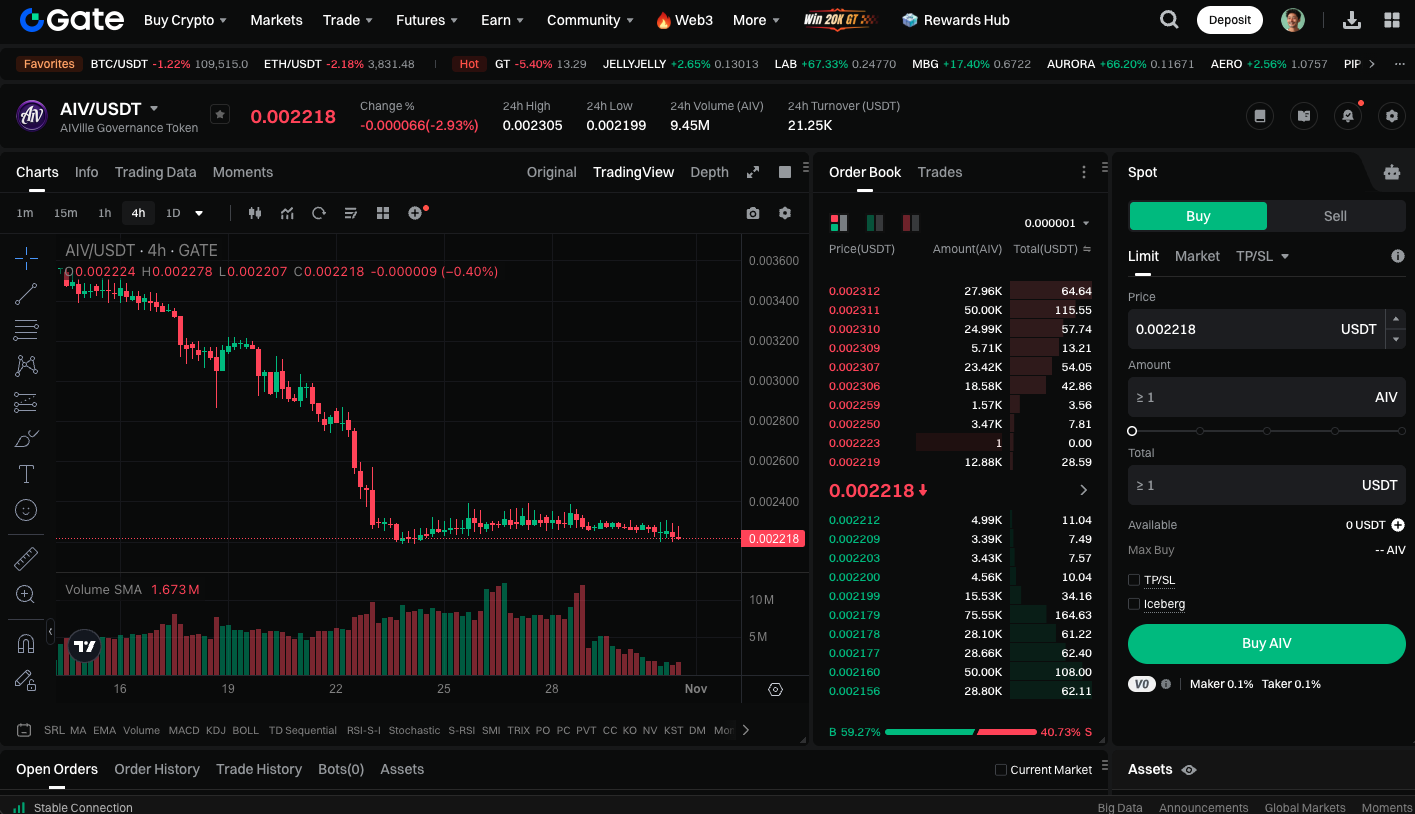
AIV spot trading is now available: https://www.gate.com/trade/AIV_USDT
Conclusion
AIVille isn’t just a virtual city—it’s a social experiment in intelligent autonomy. Powered by the $AIV token economy and governance system, players and AI together will build a decentralized, sustainable, and an evolving Web3 world.







