Vitalik Buterin’s Deep Dive into Creator Token Design: From Incentives to Non-Tokenized DAOs and Prediction Tools

Beginner
Quick Reads
Last Updated 2026-03-25 13:28:56
Reading Time: 1m
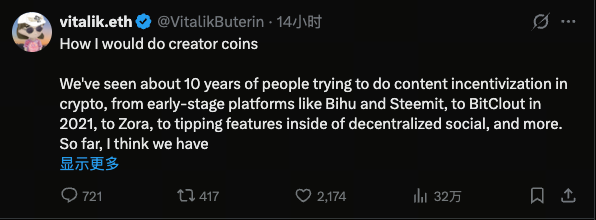
In-depth Analysis of Vitalik Buterin's Latest Remarks: Why Are Current Creator Token Incentive Mechanisms Ineffective? How Can Non-Tokenized DAOs Curate High-Quality Content and Convert Creator Tokens into Predictive Tools to Boost Ecosystem Value?


Image: https://x.com/VitalikButerin/status/2017956762347835488

1. Background: The Creator Economy and the Challenge of Crypto Incentive Mechanisms

In the Web3 era, the creator economy has emerged as a key driver of growth in the blockchain ecosystem. Issuing creator tokens theoretically enables creators to be rewarded for producing high-quality content, while allowing fans to directly participate in support and ecosystem governance. In practice, however, most token projects fail to deliver these intended results. The market is typically driven by traffic and speculation, not by the intrinsic value of quality content.

This issue is also present on traditional Web2 platforms, but crypto token mechanisms should offer more transparent and robust channels for economic incentives. Recently, Vitalik Buterin shared insightful commentary on this topic, sparking widespread industry discussion.

2. Vitalik’s Core Perspective: Incentives Do Not Equal Outcomes

Vitalik notes that the crypto industry has seen limited success in content incentivization over the past decade. The problem is not a lack of content supply, but the inability to effectively filter and amplify high-quality content. He observes that technology—especially AI—has driven down the cost of content creation, making it easier to produce large volumes of material. Without effective filtering, incentive mechanisms risk generating more noise than signal.

Traditional creator token markets are often dominated by celebrities or socially influential users. This structural flaw channels resources to a select few rather than genuine quality creators. Vitalik argues that the failure lies not in the token mechanism itself, but in the ecosystem’s lack of robust content quality filtering and governance structures.

3. Non-Tokenized DAO: A New Governance Model

To address these challenges, Vitalik proposes a significant strategy—creating a non-tokenized creator DAO. This DAO does not rely solely on tokens as the exclusive means of governance. Instead, it uses member voting to select creators, ensuring clear content focus and controlled scale.

This approach resembles Protocol Guild-type DAOs, which prioritize quality content governance over token proliferation. The central idea is to make the DAO the primary filter for high-quality creators, thereby establishing stable brand effects and commercial leverage.

4. Creator Tokens as Predictive Tools: The Rationale

In Vitalik’s framework, creator tokens evolve from simple incentives to predictive tools. When a creator is recognized and admitted to a DAO, the DAO’s revenue can be used to buy back and burn that creator’s tokens. This shifts the token’s value to reflect participants’ expectations of the creator’s future impact, rather than pure speculation.

This design reduces “recursive speculation cycles” and ties token prices more closely to DAO recognition of outstanding creators. Under this model, speculators effectively become “forecasters of quality creators,” enhancing the efficiency of content selection.

5. Potential Impact on the Creator Ecosystem and Market

If widely adopted, this design could shift the creator token market from hype-driven speculation toward a more rational, value-driven ecosystem. High-quality creators and teams would gain access to stable resources through DAO selection, while speculators would increasingly focus on forecasting and supporting top-tier content.

This mechanism could deliver several benefits:

  • Improve the discovery of high-quality content
  • Build a healthier creator economic cycle
  • Mitigate negative feedback from price volatility and speculation

However, successful implementation depends on effective DAO governance and strong curation skills among members; otherwise, the model could still become unstable.

6. Risks and Challenges

Despite its innovative potential, this approach faces several practical challenges, including:

  • How should DAO member selection criteria be defined?
  • How can governance be protected from manipulation by a minority?
  • How can predictive markets be effectively integrated with traditional mechanisms?

These issues require ongoing iteration and optimization by ecosystem designers, developers, and community participants during implementation.

7. Conclusion: The Future of Web3 Content Ecosystems

Vitalik’s perspective highlights that the true value of creator tokens lies not in simple incentives, but in building effective filtering and prediction mechanisms. Rethinking token functions and governance structures may pave the way for a healthier, higher-quality Web3 ecosystem.

As the market’s understanding of content quality and governance matures, the creator economy could be poised for a genuine transformation.

Author: Max
Disclaimer
* The information is not intended to be and does not constitute financial advice or any other recommendation of any sort offered or endorsed by Gate.
* This article may not be reproduced, transmitted or copied without referencing Gate. Contravention is an infringement of Copyright Act and may be subject to legal action.

Related Articles

AI-Native Settlement Layers: How United Stables Is Building the Next Financial Rail
Beginner

AI-Native Settlement Layers: How United Stables Is Building the Next Financial Rail

Stablecoins were originally designed as dollar substitutes within exchanges, primarily used for asset pricing and trade settlement. As on-chain financial ecosystems have matured, their role has expanded beyond simple payments to include collateral assets, cross-chain liquidity mediums, and unified settlement units. In particular, as AI systems and automated agents begin to participate directly in economic activity, demand has risen sharply for programmable value units capable of instant settlement. This shift is pushing stablecoins toward the role of foundational financial infrastructure.
2026-03-25 03:16:17
DePIN Identity Network and Real World Applications: How Humanity Protocol Brings on-chain Identity Into the Physical World
Beginner

DePIN Identity Network and Real World Applications: How Humanity Protocol Brings on-chain Identity Into the Physical World

Most Web3 identity systems remain confined to on-chain environments and struggle to achieve meaningful adoption in real world settings. Through a DePIN architecture and physical verification hardware, Humanity Protocol aims to bring decentralized identity into access control systems, hospitality, public services, and offline events, allowing on-chain identity to function not just as a digital credential, but as foundational infrastructure for real world access.
2026-03-25 07:40:53
Gold Price Forecast for the Next Five Years: 2026–2030 Trend Outlook and Investment Implications, Could It Reach $6,000?
Beginner

Gold Price Forecast for the Next Five Years: 2026–2030 Trend Outlook and Investment Implications, Could It Reach $6,000?

Analyze current gold price trends alongside authoritative five-year forecasts, integrating an evaluation of market risks and opportunities. This gives investors insight into the potential trajectory of gold prices and the main drivers expected to shape the market over the next five years.
2026-03-25 18:13:30
Aster vs Hyperliquid: Which Perp DEX Will Prevail?
Beginner

Aster vs Hyperliquid: Which Perp DEX Will Prevail?

Aster and Hyperliquid are the two representative protocols of the "purpose-built L1 path" within the current decentralized perpetual exchange (Perp DEX) sector. As a pioneer in the field, Hyperliquid has built a deep liquidity moat through its highly mature order book architecture and strong community consensus. Conversely, Aster, as a rising challenger, seeks to leapfrog the competition in high-performance trading through more aggressive multi-chain aggregation logic, private transaction modules, and an underlying execution environment optimized for 2026 market demands.
2026-03-24 11:58:33
Aerodrome Tokenomics: How ve(3,3) Powers Base's Most Profitable DEX
Beginner

Aerodrome Tokenomics: How ve(3,3) Powers Base's Most Profitable DEX

AERO is the native token of Aerodrome Finance, a core decentralized exchange and liquidity protocol in the Base ecosystem. It is primarily used for liquidity incentives and ecosystem operations. veAERO is a governance NFT that users receive by locking AERO, representing both voting power and the right to share protocol revenue. Through a dual track structure of AERO as a utility token and veAERO as a governance credential, Aerodrome separates liquidity usage value from long term governance power, allowing participants to act as liquidity providers, governance decision makers, and revenue sharers within the same system.
2026-03-25 06:40:31
The ve(3,3) Flywheel Explained: How AERO Tokenomics Powers Aerodrome’s DeFi Economy
Beginner

The ve(3,3) Flywheel Explained: How AERO Tokenomics Powers Aerodrome’s DeFi Economy

In the competition for DeFi liquidity, high-inflation mining alone is no longer enough to build lasting advantages. Aerodrome applies the ve(3,3) economic model to redesign token emissions, voting mechanisms, and revenue distribution, creating a liquidity flywheel centered on governance and cash flow. This article examines AERO tokenomics, the veAERO locking mechanism, and protocol revenue models to explain how Aerodrome builds a sustainable DeFi economic system.
2026-03-25 06:41:58