Privacy as the Key to Institutional Adoption: How ZKsync Redefines Blockchain Confidentiality

Beginner
Quick Reads
Last Updated 2026-03-27 21:34:08
Reading Time: 1m
The cryptocurrency market is pivoting from prioritizing user privacy to emphasizing institutional privacy. ZKsync utilizes a hybrid architecture that combines native private chains with ZK proofs synchronized to the public blockchain, achieving a balance among privacy, liquidity, and regulatory compliance. This signifies a pivotal moment for DeFi, as it moves from retail-driven speculation toward institutional-grade adoption.

Blockchain Privacy

During periods of cryptocurrency market volatility, privacy coins have demonstrated exceptional resilience. Historically, market attention centered on user-focused privacy projects like Zcash. Today, the spotlight is shifting toward banks and major financial institutions—traditional powerhouses now actively exploring Zero-Knowledge Proof (ZK) technology to enable blockchain transactions that are transparent yet confidential.

Matter Labs CEO Alex Gluchowski highlights that privacy exists on two levels: user-level and system-level. User-level privacy focuses on protecting account information, while system-level privacy involves institutional data segregation and internal visibility. Simply put, financial institutions must keep their own transactions transparent while ensuring outsiders cannot access their internal activities.

Verifiable Privacy

CoinGecko reports that more than 140 enterprises collectively hold around $137 billion in crypto assets. The pivotal factor in ushering institutional capital into blockchain settlement is the advancement of privacy protection layers.
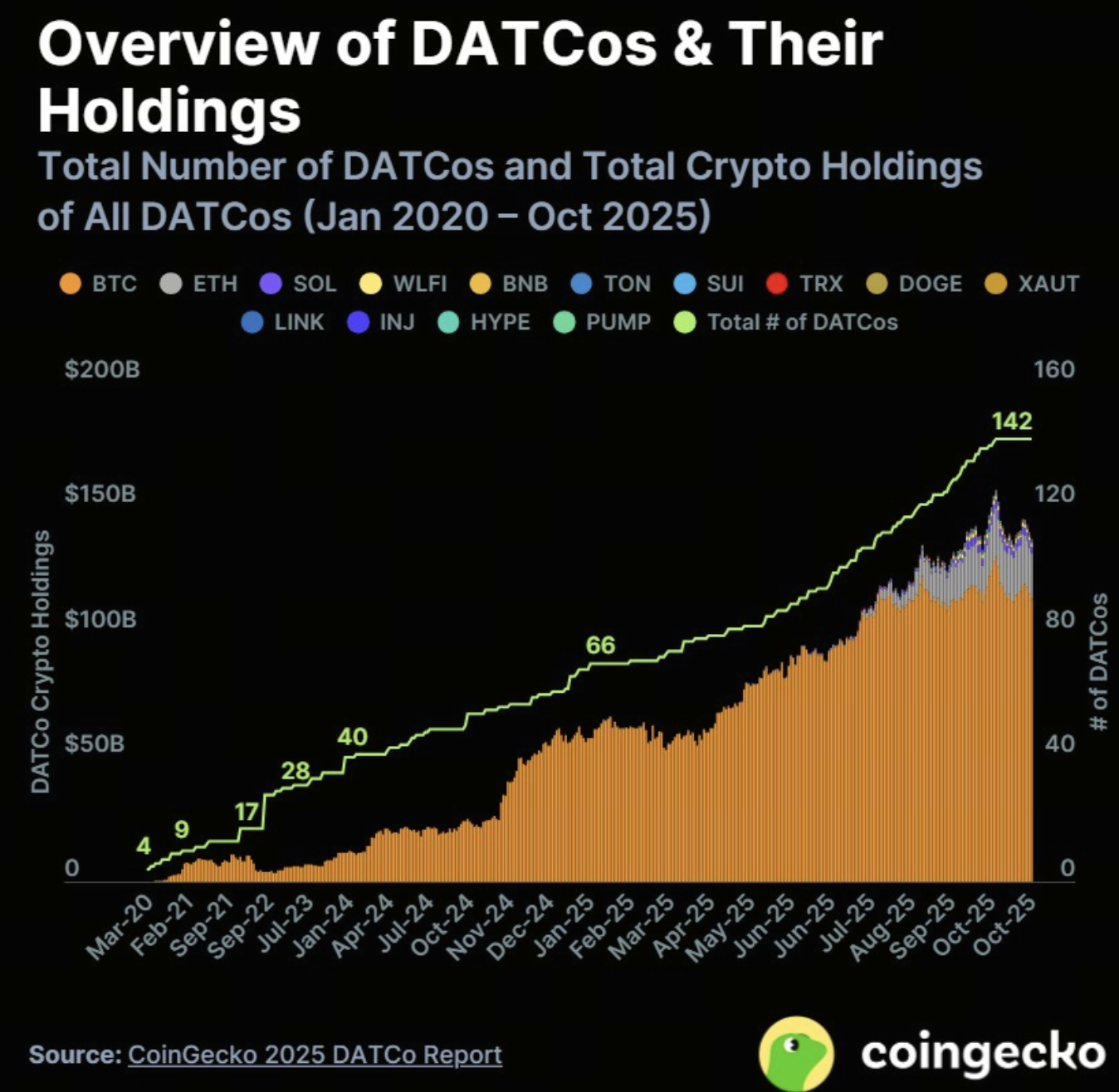

(Source: CoinGecko)

This need has driven the emergence of new technical architectures: financial institutions want to operate on public blockchains without exposing internal cash flows, counterparties, or inventory positions. ZK technology strikes this balance, allowing outsiders to verify transaction legitimacy without revealing sensitive details.

Privacy as a Functional Layer of Financial Infrastructure

In past crypto bull markets, speculative themes like meme coins and NFTs often dominated, rather than actionable technologies. As regulatory policy becomes more defined, governments are starting to distinguish between privacy technologies and illicit uses.

For instance, while Tornado Cash was previously sanctioned by U.S. authorities, those restrictions have since eased, signaling that regulators now recognize the technical necessity of privacy rather than viewing it solely as a risk.

Today, privacy is no longer the preserve of crypto idealists—it is now an essential operational function for financial institutions.

Ethereum Ecosystem Privacy Upgrades

The rise of ZKsync exemplifies this trend. The Matter Labs team is dedicated to creating a verifiable private computation environment within the Ethereum ecosystem, empowering enterprises to run internal transactions on-chain while maintaining external auditability.

Traditional private chain solutions—such as Hyperledger Fabric and Corda—provide confidentiality but remain isolated from public markets, lacking both liquidity and openness. In contrast, ZKsync enables financial institutions to process sensitive transactions on local private chains and synchronize their state with public chains via ZK proofs, achieving both privacy and public trust. Vitalik Buterin has publicly endorsed this model, noting that it introduces a new paradigm of shared liquidity to Ethereum Layer 2.
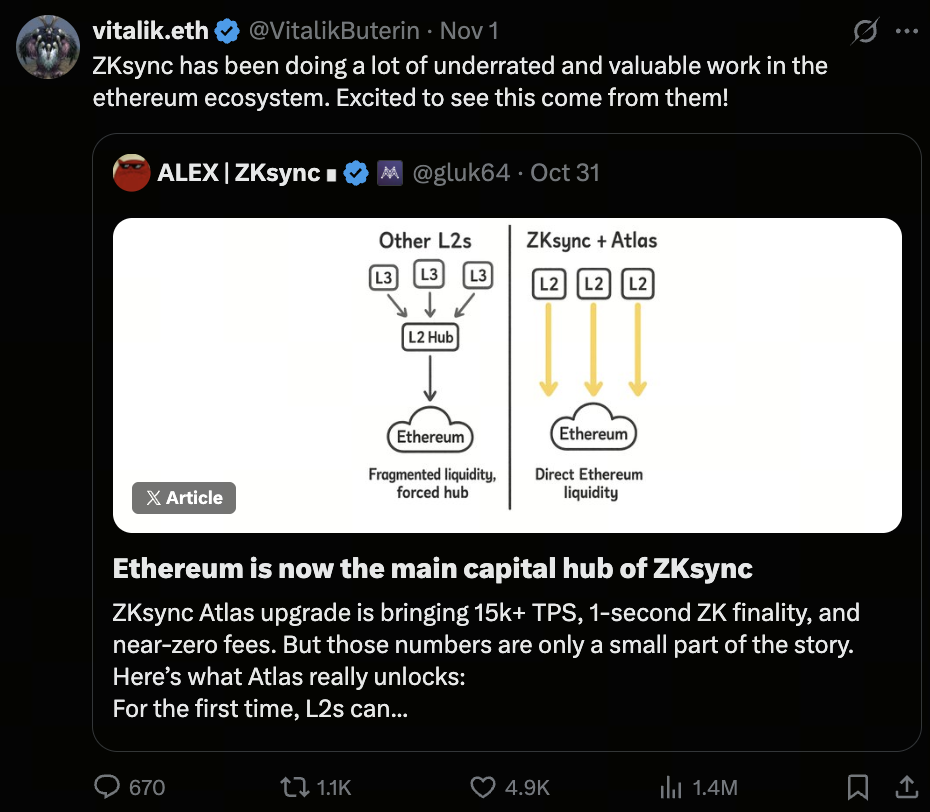

(Source: VitalikButerin)

To learn more about Web3, click to register: https://www.gate.com/

Conclusion

As the market transitions from speculation to real-world application, privacy will become the foundational layer for institutional blockchain adoption. The maturity of ZK technology enables transaction models that are both provable and private. The transformation led by ZKsync represents not just a technological breakthrough, but a turning point as decentralized finance evolves from open, retail-driven participation to institutional-grade implementation. In the next phase, the true competition will not be about price speculation, but about who can build the most trustworthy infrastructure balancing privacy and transparency.

Author: Allen
Disclaimer
* The information is not intended to be and does not constitute financial advice or any other recommendation of any sort offered or endorsed by Gate.
* This article may not be reproduced, transmitted or copied without referencing Gate. Contravention is an infringement of Copyright Act and may be subject to legal action.

Related Articles

AI-Native Settlement Layers: How United Stables Is Building the Next Financial Rail
Beginner

AI-Native Settlement Layers: How United Stables Is Building the Next Financial Rail

Stablecoins were originally designed as dollar substitutes within exchanges, primarily used for asset pricing and trade settlement. As on-chain financial ecosystems have matured, their role has expanded beyond simple payments to include collateral assets, cross-chain liquidity mediums, and unified settlement units. In particular, as AI systems and automated agents begin to participate directly in economic activity, demand has risen sharply for programmable value units capable of instant settlement. This shift is pushing stablecoins toward the role of foundational financial infrastructure.
2026-03-25 03:16:17
The ve(3,3) Flywheel Explained: How AERO Tokenomics Powers Aerodrome’s DeFi Economy
Beginner

The ve(3,3) Flywheel Explained: How AERO Tokenomics Powers Aerodrome’s DeFi Economy

In the competition for DeFi liquidity, high-inflation mining alone is no longer enough to build lasting advantages. Aerodrome applies the ve(3,3) economic model to redesign token emissions, voting mechanisms, and revenue distribution, creating a liquidity flywheel centered on governance and cash flow. This article examines AERO tokenomics, the veAERO locking mechanism, and protocol revenue models to explain how Aerodrome builds a sustainable DeFi economic system.
2026-03-25 06:41:58
Aerodrome Tokenomics: How ve(3,3) Powers Base's Most Profitable DEX
Beginner

Aerodrome Tokenomics: How ve(3,3) Powers Base's Most Profitable DEX

AERO is the native token of Aerodrome Finance, a core decentralized exchange and liquidity protocol in the Base ecosystem. It is primarily used for liquidity incentives and ecosystem operations. veAERO is a governance NFT that users receive by locking AERO, representing both voting power and the right to share protocol revenue. Through a dual track structure of AERO as a utility token and veAERO as a governance credential, Aerodrome separates liquidity usage value from long term governance power, allowing participants to act as liquidity providers, governance decision makers, and revenue sharers within the same system.
2026-03-25 06:40:31
DePIN Identity Network and Real World Applications: How Humanity Protocol Brings on-chain Identity Into the Physical World
Beginner

DePIN Identity Network and Real World Applications: How Humanity Protocol Brings on-chain Identity Into the Physical World

Most Web3 identity systems remain confined to on-chain environments and struggle to achieve meaningful adoption in real world settings. Through a DePIN architecture and physical verification hardware, Humanity Protocol aims to bring decentralized identity into access control systems, hospitality, public services, and offline events, allowing on-chain identity to function not just as a digital credential, but as foundational infrastructure for real world access.
2026-03-25 07:40:53
How is the price of PAXG determined? Pegging mechanism, trading depth, and influencing factors
Beginner

How is the price of PAXG determined? Pegging mechanism, trading depth, and influencing factors

PAXG (Pax Gold) is a tokenized asset backed by physical gold reserves, launched by fintech firm Paxos and issued as an ERC-20 token on the Ethereum blockchain. The core concept is to digitally represent real-world gold assets, allowing investors to hold and trade gold via the blockchain network. Because each PAXG token corresponds to a specific quantity of physical gold, its price is theoretically expected to closely track the global gold market.
2026-03-24 19:11:40
Aster vs Hyperliquid: Which Perp DEX Will Prevail?
Beginner

Aster vs Hyperliquid: Which Perp DEX Will Prevail?

Aster and Hyperliquid are the two representative protocols of the "purpose-built L1 path" within the current decentralized perpetual exchange (Perp DEX) sector. As a pioneer in the field, Hyperliquid has built a deep liquidity moat through its highly mature order book architecture and strong community consensus. Conversely, Aster, as a rising challenger, seeks to leapfrog the competition in high-performance trading through more aggressive multi-chain aggregation logic, private transaction modules, and an underlying execution environment optimized for 2026 market demands.
2026-03-24 11:58:33





