Pi Network Rebounds 35% Ahead of Pi2Day: Can the Price Rally Continue?

Last Updated 2026-04-03 23:08:05
Reading Time: 1m
Pi Network rebounded 35% before Pi2Day, attracting strong market attention. This article delves into the rebound dynamics of Pi (PI), short-term risks, and the uncertainties behind the Pi2Day event.

Pi (PI) Weekly Price Trend Review
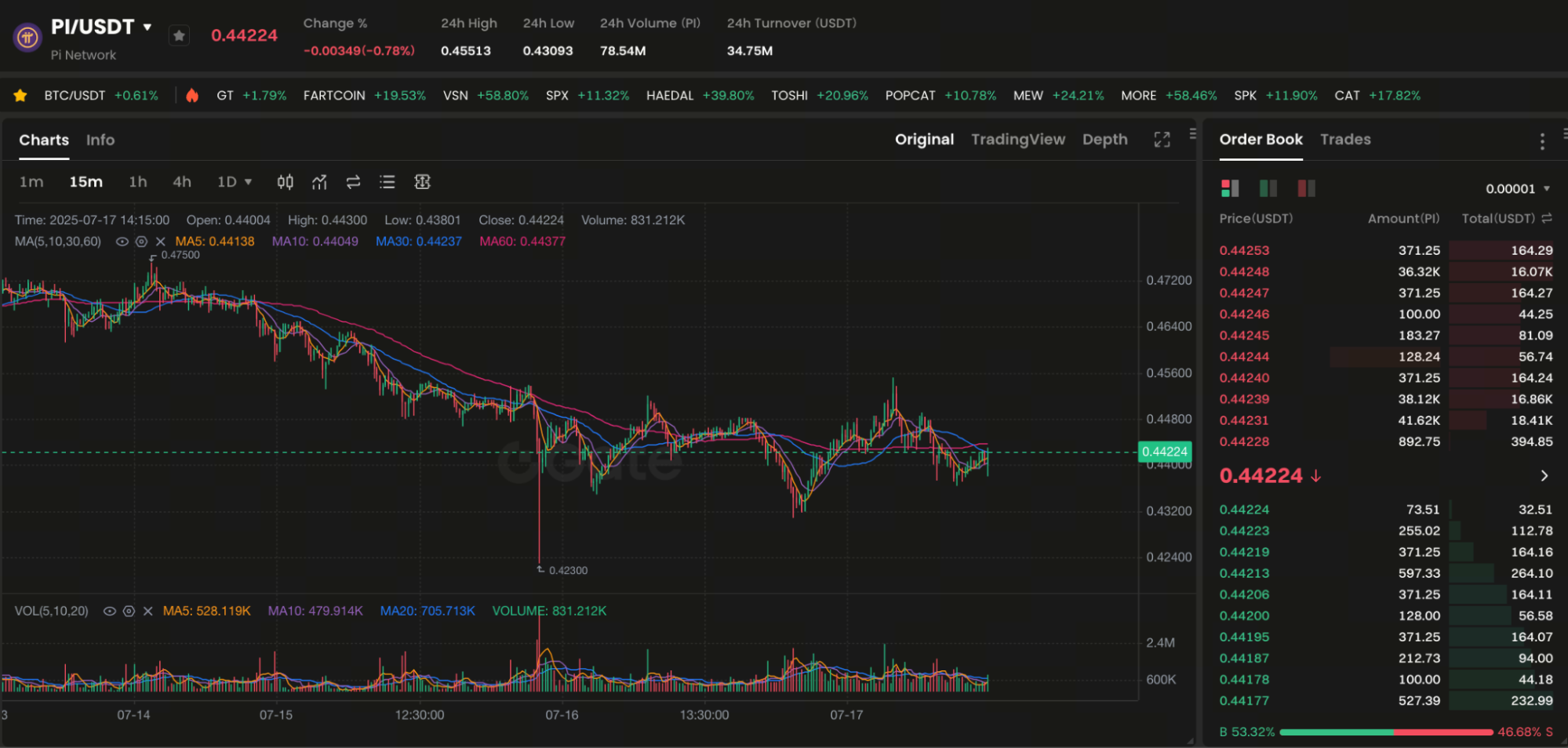

Figure:https://www.gate.com/trade/PI_USDT

On June 23, 2025, the native token PI of Pi Network fell to $0.47, reaching a recent low. Subsequently, the market quickly reversed, rising for three consecutive days, and on June 26, it peaked at $0.66 during the trading session, with a cumulative increase of 35%. However, there was significant selling pressure at the high point, and it closed that day around $0.55.

This wave of V-shaped Rebound has attracted widespread attention from the market and has also focused attention on the upcoming annual community event - Pi2Day.

Factors Driving the V-Shaped Rebound

This round of Rebound is not without a source. First of all, Pi2Day is held on June 28 every year and is one of the most important commemorative events for the Pi community, historically often accompanied by key updates such as mainnet progress, application layer ecosystem announcements, KYC policy updates, and so on.

Secondly, social media has spread speculation about the mainnet launch and comments about “major news coming soon” in a short time, creating a significant sense of FOMO (Fear of Missing Out). In addition, there are reports from some exchanges that they may open trading pairs for Pi, although it has not been officially announced yet, this kind of positive expectation has accelerated buying.

Short-term Rebound and Profit-taking Pressure

However, the 35% rapid increase also brings concerns. A large number of sell orders have appeared in the high-price area, indicating that many early mining users have chosen to cash out their profits before Pi2Day. Considering that the current circulation of Pi mainly comes from the “free output” of early users, this kind of profit-taking exerts strong pressure on the price.

In addition, some trading platforms only allow IOU trading, and the actual mainnet tokens have not yet fully circulated, which can lead investors to overestimate the actual market value and liquidity, further exacerbating volatility.

Market sentiment and expectations before Pi2Day

The community has high hopes for the Pi2Day event. Especially against the backdrop of the mainnet not yet fully launched and the relatively weak ecological applications, a successful event could become an important milestone for boosting confidence in the project.

However, one should also be wary of the typical phenomenon in the crypto market where “good news leads to selling”. If the content of the activity is insufficient or no significant breakthroughs are announced, the current high expectations may quickly turn into selling pressure.

Risk points that investors should pay attention to

  1. KYC and Mainnet Restrictions: Currently, there are still a large number of users who have not completed verification and are unable to participate in trading, resulting in insufficient liquidity.
  2. Token release rhythm: Once the mainnet is fully open, if the unlocking is too fast, it may create pressure on the price.
  3. Official information is not transparent: The current official roadmap and economic model of the Pi Network still have many unknowns, making it difficult to fully assess the risks.

Mid-term Outlook and Personal Investment Recommendations

The 35% rebound of Pi Network before Pi2Day indicates that the market still has enthusiasm, but the lack of fundamental support will make the short-term price unstable. It is recommended that investors:

  • Participate with a small position cautiously, and do not blindly chase highs;
  • Pay attention to official news; prices may fluctuate after the event ends.
  • Pay attention to KYC and unlocking announcements, as they are key references for mid-term layout.
Author: Max
Disclaimer
* The information is not intended to be and does not constitute financial advice or any other recommendation of any sort offered or endorsed by Gate.
* This article may not be reproduced, transmitted or copied without referencing Gate. Contravention is an infringement of Copyright Act and may be subject to legal action.

Related Articles

The ve(3,3) Flywheel Explained: How AERO Tokenomics Powers Aerodrome’s DeFi Economy
Beginner

The ve(3,3) Flywheel Explained: How AERO Tokenomics Powers Aerodrome’s DeFi Economy

In the competition for DeFi liquidity, high-inflation mining alone is no longer enough to build lasting advantages. Aerodrome applies the ve(3,3) economic model to redesign token emissions, voting mechanisms, and revenue distribution, creating a liquidity flywheel centered on governance and cash flow. This article examines AERO tokenomics, the veAERO locking mechanism, and protocol revenue models to explain how Aerodrome builds a sustainable DeFi economic system.
2026-03-25 06:41:58
AI-Native Settlement Layers: How United Stables Is Building the Next Financial Rail
Beginner

AI-Native Settlement Layers: How United Stables Is Building the Next Financial Rail

Stablecoins were originally designed as dollar substitutes within exchanges, primarily used for asset pricing and trade settlement. As on-chain financial ecosystems have matured, their role has expanded beyond simple payments to include collateral assets, cross-chain liquidity mediums, and unified settlement units. In particular, as AI systems and automated agents begin to participate directly in economic activity, demand has risen sharply for programmable value units capable of instant settlement. This shift is pushing stablecoins toward the role of foundational financial infrastructure.
2026-03-25 03:16:17
Aerodrome Tokenomics: How ve(3,3) Powers Base's Most Profitable DEX
Beginner

Aerodrome Tokenomics: How ve(3,3) Powers Base's Most Profitable DEX

AERO is the native token of Aerodrome Finance, a core decentralized exchange and liquidity protocol in the Base ecosystem. It is primarily used for liquidity incentives and ecosystem operations. veAERO is a governance NFT that users receive by locking AERO, representing both voting power and the right to share protocol revenue. Through a dual track structure of AERO as a utility token and veAERO as a governance credential, Aerodrome separates liquidity usage value from long term governance power, allowing participants to act as liquidity providers, governance decision makers, and revenue sharers within the same system.
2026-03-25 06:40:31
How Does PAXG Work? In-Depth Overview of the Physical Gold Tokenization Mechanism
Beginner

How Does PAXG Work? In-Depth Overview of the Physical Gold Tokenization Mechanism

PAXG (Pax Gold) is a tokenized asset backed by physical gold, issued by the fintech company Paxos and traded on the Ethereum blockchain as an ERC-20 token. The core concept is to tokenize physical gold on-chain, with each PAXG token representing ownership of a certain amount of gold. This structure enables investors to hold and trade gold in the form of a digital asset.
2026-03-24 19:12:51
How is the price of PAXG determined? Pegging mechanism, trading depth, and influencing factors
Beginner

How is the price of PAXG determined? Pegging mechanism, trading depth, and influencing factors

PAXG (Pax Gold) is a tokenized asset backed by physical gold reserves, launched by fintech firm Paxos and issued as an ERC-20 token on the Ethereum blockchain. The core concept is to digitally represent real-world gold assets, allowing investors to hold and trade gold via the blockchain network. Because each PAXG token corresponds to a specific quantity of physical gold, its price is theoretically expected to closely track the global gold market.
2026-03-24 19:11:40
DePIN Identity Network and Real World Applications: How Humanity Protocol Brings on-chain Identity Into the Physical World
Beginner

DePIN Identity Network and Real World Applications: How Humanity Protocol Brings on-chain Identity Into the Physical World

Most Web3 identity systems remain confined to on-chain environments and struggle to achieve meaningful adoption in real world settings. Through a DePIN architecture and physical verification hardware, Humanity Protocol aims to bring decentralized identity into access control systems, hospitality, public services, and offline events, allowing on-chain identity to function not just as a digital credential, but as foundational infrastructure for real world access.
2026-03-25 07:40:53





