As Web3 demand for a “Verifiable Data Layer” continues to grow, storage alone is no longer enough to meet application needs. The token model must also support data uploads, verification execution, and long-term availability. This makes IRYS not only a payment tool, but also the economic foundation of network operation.
From the perspective of blockchain and data infrastructure, the key question behind IRYS tokenomics is how fees, incentives, and staking mechanisms can turn “data storage behavior” into a sustainable economic system.
The Role of the IRYS Token in the Irys Ecosystem
IRYS plays the role of a “multi-functional base asset” within the Irys network, rather than serving as a single-purpose token. It functions both as a payment medium and as part of the network’s security mechanism.
First, at the usage level, IRYS is the unit of account for all network operations. Whether users are uploading data, querying data, or executing programmable data, they need to pay fees in IRYS. This makes it the “Gas + settlement asset” of the entire data layer.
Second, at the security level, IRYS binds node behavior through staking. Miners and validators must stake tokens to participate in the network. If they act maliciously, they may face slashing.
In addition, IRYS provides economic support for long-term data commitments. Through the Endowment reserve mechanism, the protocol helps cover future storage costs, giving “long-term data availability” an economic foundation.
Source: irys.xyz
IRYS Token Supply: Supply Structure and Issuance Mechanism
IRYS has a maximum supply of 10 billion tokens. Its design uses a “pre-allocation + gradual release” structure to balance early-stage development with long-term stability.
At the initial stage, or TGE, about 20% of tokens enter circulation, while the remaining portion is gradually released through vesting. This design helps avoid a short-term supply shock while reserving room for ecosystem development.
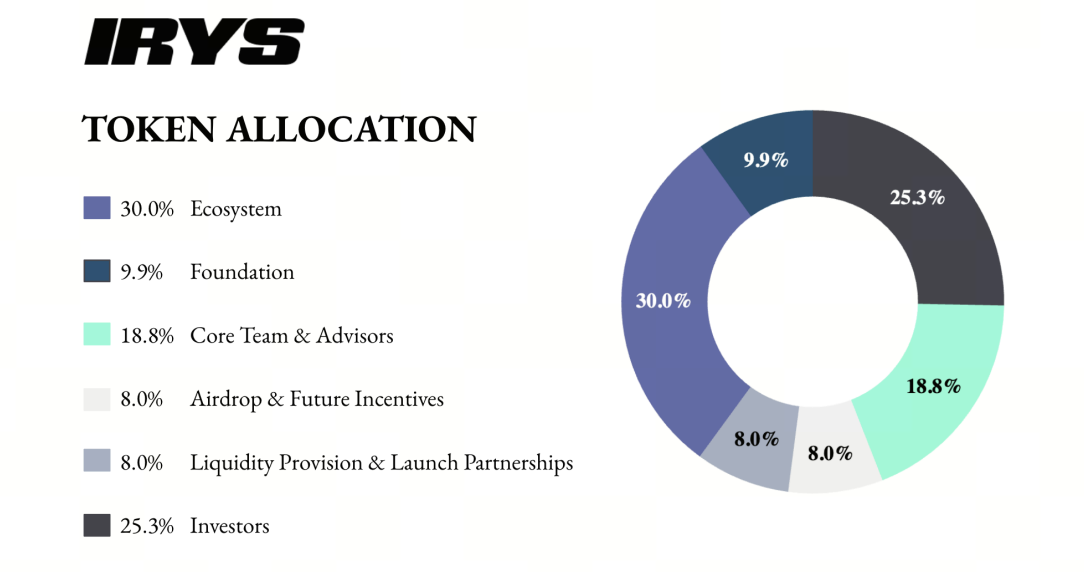
From a distribution perspective, IRYS uses a multi-category allocation model: ecosystem, 30%; investors, 25.3%; team and advisors, 18.8%; foundation, 9.9%; incentives and airdrops, 8%; liquidity, 8%. This structure reflects an “ecosystem-first” design logic.
In terms of issuance, IRYS uses an inflation model, but the inflation is controlled. The initial annualized inflation rate is about 2% and halves every four years, eventually approaching 0.25%. This design resembles a declining issuance curve, intended to incentivize the network in its early stages and shift toward stability later.
Storage Fee Mechanism: How Users Pay Data Storage Costs
Irys’s fee model differs clearly from that of traditional blockchains. Its core focus is “data storage pricing.”
When users upload data, they need to pay IRYS as a fee. These fees cover the costs of data writing, storage, and accessibility. Unlike purely computation-based chains, these fees are directly related to “data size and storage duration.”
One key design is that Irys uses a pricing mechanism anchored to U.S. dollar costs and adjusted annually. This means the actual storage cost paid by users remains relatively stable and does not fluctuate sharply due to token price volatility.
This model makes Irys closer to “infrastructure pricing” than a speculative fee system. As a result, it improves predictability for developers and reduces uncertainty around long-term application deployment.
Node Incentive Mechanism: How Storage and Verification Behavior Is Driven
Irys’s node incentive mechanism centers on “data storage + network security.” It is the core force that keeps the entire system running.
First, miners and validators receive IRYS through block rewards. These rewards come from newly issued tokens and are used to incentivize nodes to participate in data storage and consensus maintenance.
Second, nodes must stake tokens as a prerequisite for participating in the network. This “staking + rewards” structure allows nodes to earn returns while also taking on responsibility.
In addition, Irys requires nodes to continuously provide services through data verification mechanisms, such as data sampling and availability proofs. This means rewards depend not only on participation, but also on “real contribution.”
The Source of IRYS Value: Data Demand and Network Usage
The value logic of IRYS does not depend on a single factor. It is driven by “data demand.”
When users upload more data and execute more computation, demand for IRYS increases. This demand comes from real usage, not speculation alone.
At the same time, as Web3 applications grow, including NFT, AI data, and DeFi data layer use cases, Irys’s usage frequency as data infrastructure may rise, strengthening the token’s economic role.
In the long run, the value of IRYS depends on one core relationship: data usage → network revenue → token demand → value support. This is a typical “usage-driven model.”
Tokenomics Risks: Costs, Incentives, and Sustainability
Although the IRYS design is relatively complete, its tokenomics still faces structural challenges.
The first challenge is balancing inflation and incentives. In the early stage, issuance rewards help drive network growth, but if real demand does not grow at the same pace, a supply-demand mismatch may emerge.
The second is cost model risk. Although Irys uses U.S. dollar-anchored pricing, whether long-term storage costs remain sustainable still depends on real market conditions and changes in hardware costs.
The third is network participation risk. If node incentives are insufficient, data availability may be affected. Conversely, if incentives are too high, resources may be wasted.
Therefore, the core challenge for the IRYS model is balancing three factors: usage demand, incentive intensity, and system cost.
Summary
IRYS’s tokenomics is essentially a “data-driven economic system.” Through fees, incentives, and staking mechanisms, it turns data storage behavior into a sustainable network structure.
Its core logic can be summarized as follows: use tokens to pay for data, use incentives to maintain nodes, and use demand to drive value. As the network moves from the early incentive stage toward maturity, the long-term value of IRYS will depend more on real data demand than on the issuance mechanism itself.
FAQ
- What is IRYS mainly used for?
IRYS is used to pay storage fees, participate in staking, earn rewards, and execute on-chain data operations.
- Is IRYS an inflationary token?
Yes, but its inflation rate is controlled and follows a declining model that halves every four years.
- Why are Irys fees anchored to the U.S. dollar?
To provide stable and predictable storage costs and prevent token price fluctuations from affecting usage.
- How does IRYS ensure long-term data storage?
Through the Endowment mechanism and node incentives, which help ensure that future storage costs are covered.
- Where does the value of IRYS come from?
It mainly comes from demand for data uploads, storage, and usage, rather than simple trading or speculation.







