IMU 60-Day Fixed-Term Savings Launch: Gate Simple Earn Offers Limited-Time APY Up to 260%

Last Updated 2026-03-25 18:29:09
Reading Time: 1m
Gate has introduced a limited-time IMU 60-day fixed-term Earn product with an annualized yield reaching up to 260%. The total supply is capped at 46,000,000 IMU and will be available on a first-come, first-served basis. This offering is ideal for users looking for mid-term investment opportunities.

Gate Introduces IMU 60-Day High-Yield Fixed-Term Simple Earn Product
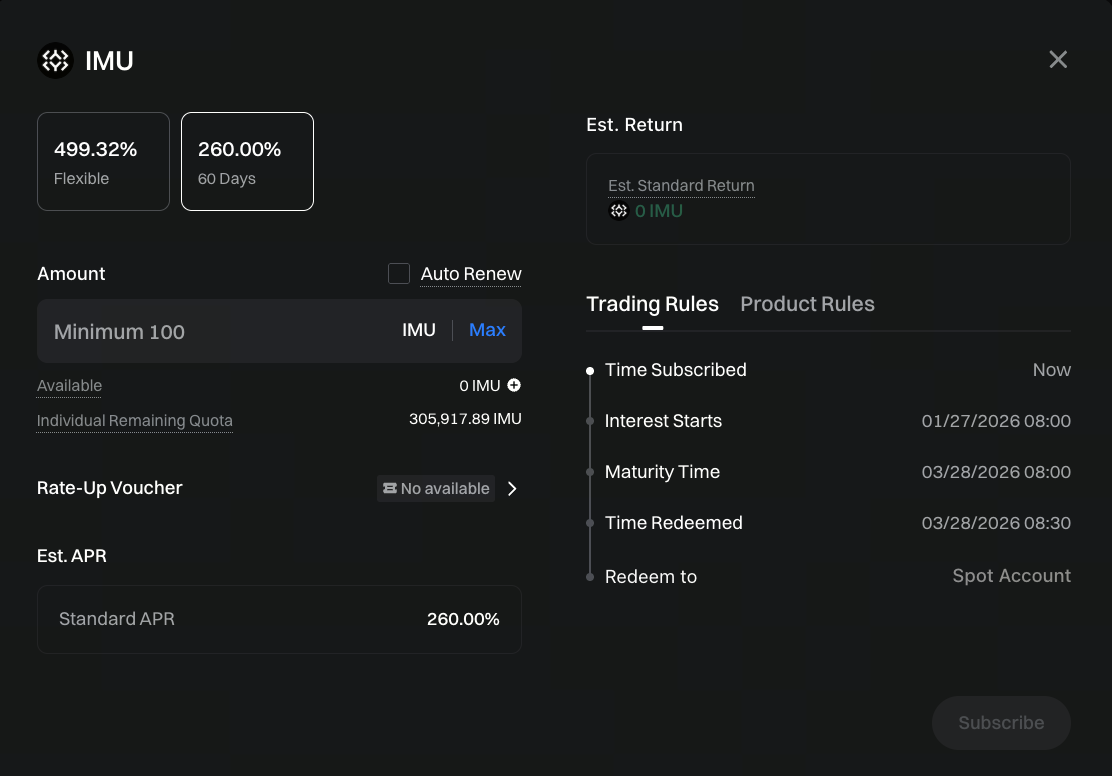

Image: https://www.gate.com/simple-earn?asset=IMU&product_id=330&product_type_tag=1

Gate Simple Earn has officially launched the IMU 60-day fixed-term product, offering users a mid-term lock-up solution with high annualized returns. The product features a reference annualized yield of up to 260%, with a total subscription cap of 46,000,000 IMU. It is available in limited quantities and will remain open until sold out. The subscription period runs from January 22, 2026, 2:30 p.m. to March 23, 2026, 2:30 p.m. (UTC), making it suitable for users with long-term confidence in the IMU project who wish to boost asset yield efficiency through lock-up participation.

60-Day Lock-Up Mechanism and Yield Distribution

The IMU fixed-term product implements a 60-day lock-up period. Once a subscription is successful, users must hold until maturity; early redemption is not supported. Upon maturity, the system will distribute both principal and interest in accordance with product rules, with interest paid in IMU tokens directly to the user’s account. Users can view detailed earnings on the “Simple Earn Records” – “Fixed-Term” – “Interest Earnings” page. This product offers a clear investment outlook through its defined cycle and yield structure.

IMU Project Background: Immunefi Security Ecosystem Overview

IMU is the core token of the Immunefi ecosystem. Immunefi is a widely recognized security infrastructure platform in the blockchain sector, with its core platform dedicated to zero-day vulnerability protection and bug bounty mechanisms. It helps blockchain projects defend against potentially catastrophic code-level attacks. Across the broader ecosystem, Immunefi collaborates with platforms, partners, and security researchers to build an on-chain security network. The IMU token serves as the key link for ecosystem collaboration and incentives, supporting the long-term operation of the security network.

Participation Guidelines and Risk Disclosure

This IMU fixed-term product is offered on a limited-time, limited-quantity basis. Please refer to the subscription page for specific rules regarding subscription, redemption, and interest distribution. To ensure fairness, any form of cheating during the event is strictly prohibited and will result in disqualification. Please note that crypto asset investments are subject to market conditions, regulatory changes, and other factors, and returns are not guaranteed. Users should carefully assess their risk tolerance and make rational asset allocations before participating. Additionally, users from the UK and other restricted regions are currently unable to access this service; restrictions are governed by the Gate User Agreement.

Author: Max
Disclaimer
* The information is not intended to be and does not constitute financial advice or any other recommendation of any sort offered or endorsed by Gate.
* This article may not be reproduced, transmitted or copied without referencing Gate. Contravention is an infringement of Copyright Act and may be subject to legal action.

Related Articles

AI-Native Settlement Layers: How United Stables Is Building the Next Financial Rail
Beginner

AI-Native Settlement Layers: How United Stables Is Building the Next Financial Rail

Stablecoins were originally designed as dollar substitutes within exchanges, primarily used for asset pricing and trade settlement. As on-chain financial ecosystems have matured, their role has expanded beyond simple payments to include collateral assets, cross-chain liquidity mediums, and unified settlement units. In particular, as AI systems and automated agents begin to participate directly in economic activity, demand has risen sharply for programmable value units capable of instant settlement. This shift is pushing stablecoins toward the role of foundational financial infrastructure.
2026-03-25 03:16:17
The ve(3,3) Flywheel Explained: How AERO Tokenomics Powers Aerodrome’s DeFi Economy
Beginner

The ve(3,3) Flywheel Explained: How AERO Tokenomics Powers Aerodrome’s DeFi Economy

In the competition for DeFi liquidity, high-inflation mining alone is no longer enough to build lasting advantages. Aerodrome applies the ve(3,3) economic model to redesign token emissions, voting mechanisms, and revenue distribution, creating a liquidity flywheel centered on governance and cash flow. This article examines AERO tokenomics, the veAERO locking mechanism, and protocol revenue models to explain how Aerodrome builds a sustainable DeFi economic system.
2026-03-25 06:41:58
Aerodrome Tokenomics: How ve(3,3) Powers Base's Most Profitable DEX
Beginner

Aerodrome Tokenomics: How ve(3,3) Powers Base's Most Profitable DEX

AERO is the native token of Aerodrome Finance, a core decentralized exchange and liquidity protocol in the Base ecosystem. It is primarily used for liquidity incentives and ecosystem operations. veAERO is a governance NFT that users receive by locking AERO, representing both voting power and the right to share protocol revenue. Through a dual track structure of AERO as a utility token and veAERO as a governance credential, Aerodrome separates liquidity usage value from long term governance power, allowing participants to act as liquidity providers, governance decision makers, and revenue sharers within the same system.
2026-03-25 06:40:31
How Does PAXG Work? In-Depth Overview of the Physical Gold Tokenization Mechanism
Beginner

How Does PAXG Work? In-Depth Overview of the Physical Gold Tokenization Mechanism

PAXG (Pax Gold) is a tokenized asset backed by physical gold, issued by the fintech company Paxos and traded on the Ethereum blockchain as an ERC-20 token. The core concept is to tokenize physical gold on-chain, with each PAXG token representing ownership of a certain amount of gold. This structure enables investors to hold and trade gold in the form of a digital asset.
2026-03-24 19:12:51
How is the price of PAXG determined? Pegging mechanism, trading depth, and influencing factors
Beginner

How is the price of PAXG determined? Pegging mechanism, trading depth, and influencing factors

PAXG (Pax Gold) is a tokenized asset backed by physical gold reserves, launched by fintech firm Paxos and issued as an ERC-20 token on the Ethereum blockchain. The core concept is to digitally represent real-world gold assets, allowing investors to hold and trade gold via the blockchain network. Because each PAXG token corresponds to a specific quantity of physical gold, its price is theoretically expected to closely track the global gold market.
2026-03-24 19:11:40
DePIN Identity Network and Real World Applications: How Humanity Protocol Brings on-chain Identity Into the Physical World
Beginner

DePIN Identity Network and Real World Applications: How Humanity Protocol Brings on-chain Identity Into the Physical World

Most Web3 identity systems remain confined to on-chain environments and struggle to achieve meaningful adoption in real world settings. Through a DePIN architecture and physical verification hardware, Humanity Protocol aims to bring decentralized identity into access control systems, hospitality, public services, and offline events, allowing on-chain identity to function not just as a digital credential, but as foundational infrastructure for real world access.
2026-03-25 07:40:53





