Gate DEX 0 Gas Trading Guide: Full Breakdown of the Gas-Free Spring Campaign Rules and How to Participate

Beginner
Quick Reads
Last Updated 2026-03-24 23:21:24
Reading Time: 1m
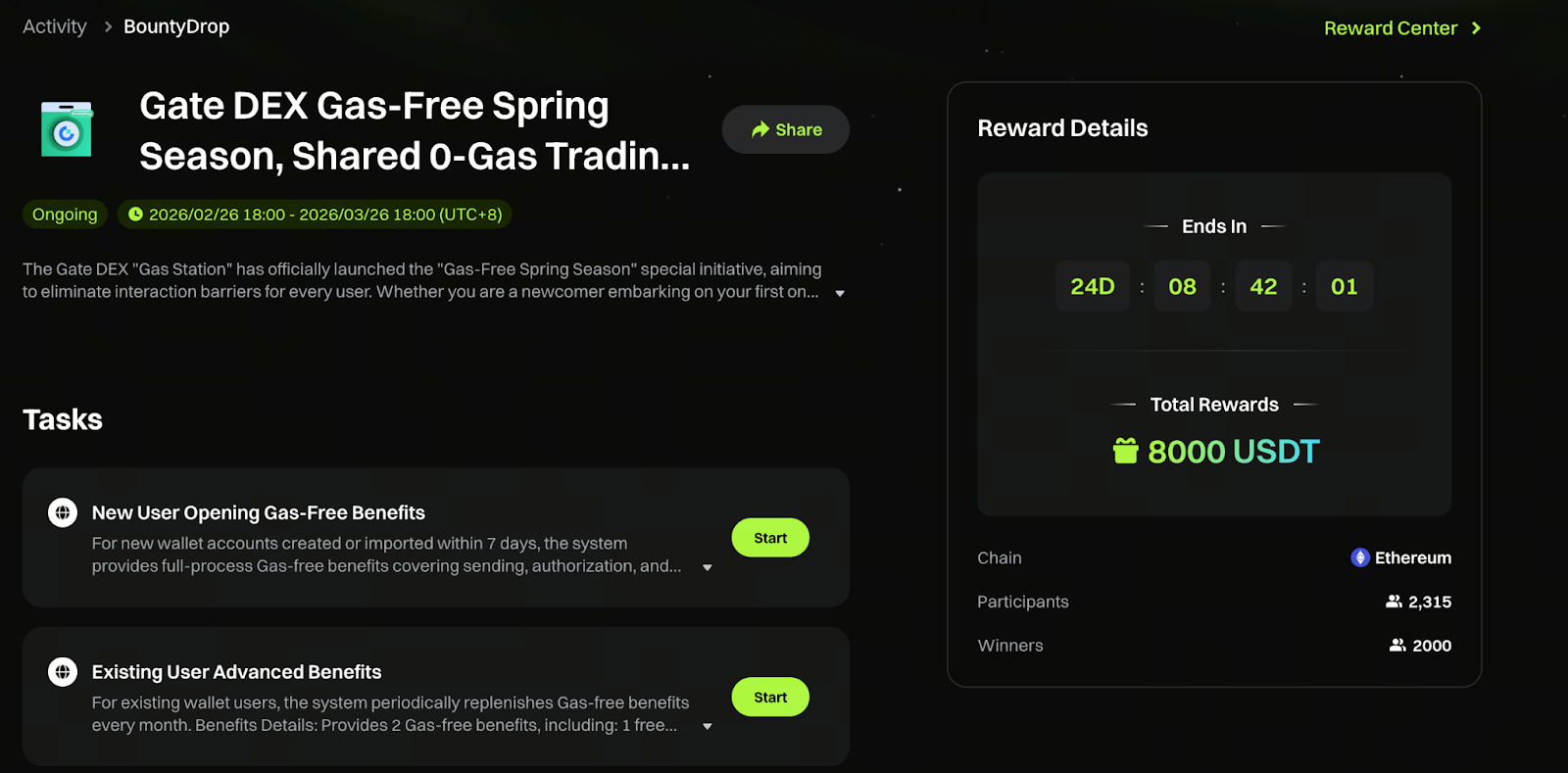
Gate DEX introduces the Zero Gas Spring Promotion, granting all users—new and existing—the benefit of gas-free trading. This article delivers an in-depth analysis of the event rules, device restriction system, and essential considerations for participants.

Gate DEX 0 Gas Trading Guide: Spring Gas-Free Event Rules and Participation Overview
Image: https://www.gatedex.com/activity/detail?id=577&network=EVM

Gas fees are a persistent concern in on-chain trading. Every action—authorization, transfer, or trade—incurs a network fee. When market activity heats up, gas costs can significantly impact trading decisions.

To address this challenge, Gate DEX is introducing the Spring Gas-Free Event. Through a Gas Station mechanism, the platform offers 0 gas trading support tailored to users at different stages.

This article systematically analyzes the event’s mechanism, target users, device rules, and practical value.

Why Do Gas Costs Affect the On-Chain Trading Experience?

On-chain, gas is more than just a network fee—it’s part of the access barrier:

  • Wallets must hold native tokens to initiate any transaction
  • Each authorization requires an extra gas payment
  • Multiple signatures increase both fees and operational complexity

For new users, the gas mechanism often makes onboarding more difficult.

For high-frequency traders, the cumulative cost is equally significant.

Gas-free isn’t just a fee waiver—it’s a structural upgrade to the user interaction threshold.

What Are the Event’s Core Benefits?

The event covers new users, existing users, and first-time recharge scenarios.

Exclusive Gas-Free Benefits for New Users

For wallet accounts created or imported within the past 7 days, the system offers:

  • One gas-free token transfer
  • One gas-free token authorization
  • One gas-free trade

This covers the most common on-chain operations, helping users complete the full interaction loop during their first experience.

Monthly Gas-Free Supplement for Existing Users

For all existing wallet accounts:

  • One gas-free token authorization
  • One gas-free trade

Benefits are renewed monthly, encouraging continued engagement from current users.

First Recharge Gas Subsidy Mechanism

During the event, for the first recharge of 5–100 USDT to the Gas Station:

  • No gas payment required
  • Recharge can be completed even if the wallet has no native tokens
  • The platform covers all network fees

This mechanism solves the recurring problem of “no gas, no recharge.”

How Does the Device ID Mechanism Ensure Fairness?

To prevent multi-account arbitrage, the event uses physical device ID binding:

  • Each device is permanently limited to one new wallet account for new user benefits
  • Each device can use one existing wallet account per month for gas-free benefits
  • Once triggered, other wallet accounts on the same device cannot claim benefits for that month

This approach controls costs and ensures event resources go to genuine users.

What Does Gas-Free Mean for Different Users?

For New Users

  • Reduces psychological barriers for first on-chain interaction
  • No need to prepare native gas assets in advance
  • Smoother completion of initial authorization and trade

For Active Traders

  • Reduces marginal costs for frequent operations
  • Optimizes authorization and trading experience
  • Boosts execution efficiency on-chain

For Long-Term Users

  • Strengthens user retention
  • Provides periodic cost relief

Does Gas-Free Change the Structure of On-Chain Trading?

From a product standpoint, the Gas Station is not just a marketing tool—it’s part of the on-chain infrastructure.

When the platform starts subsidizing and optimizing gas, it signals that on-chain trading is moving toward scalable adoption.

Gate DEX combines phased subsidies with rule-based restrictions to strike a balance between user experience and risk control.

Event Participation Notes

  • Event period: February 26, 2026, 6:00 p.m. — March 26, 2026, 6:00 p.m. (UTC+8)
  • Benefits from Event 1 and Event 2 cannot be claimed repeatedly
  • Benefits from Event 3 can be combined
  • Abnormal multi-account activity will be restricted

If there is any discrepancy between the translated version and the English version, the English version takes precedence.

Conclusion

As the on-chain ecosystem expands, gas costs remain a major factor affecting user experience. With the Spring Gas-Free Event, Gate DEX offers staged cost optimization for users at every phase, lowering barriers and improving transaction fluidity.

Going forward, optimizing transaction efficiency and cost structure may become a key competitive focus for on-chain platforms.

Author: Max
Disclaimer
* The information is not intended to be and does not constitute financial advice or any other recommendation of any sort offered or endorsed by Gate.
* This article may not be reproduced, transmitted or copied without referencing Gate. Contravention is an infringement of Copyright Act and may be subject to legal action.

Related Articles

The ve(3,3) Flywheel Explained: How AERO Tokenomics Powers Aerodrome’s DeFi Economy
Beginner

The ve(3,3) Flywheel Explained: How AERO Tokenomics Powers Aerodrome’s DeFi Economy

In the competition for DeFi liquidity, high-inflation mining alone is no longer enough to build lasting advantages. Aerodrome applies the ve(3,3) economic model to redesign token emissions, voting mechanisms, and revenue distribution, creating a liquidity flywheel centered on governance and cash flow. This article examines AERO tokenomics, the veAERO locking mechanism, and protocol revenue models to explain how Aerodrome builds a sustainable DeFi economic system.
2026-03-25 06:41:58
AI-Native Settlement Layers: How United Stables Is Building the Next Financial Rail
Beginner

AI-Native Settlement Layers: How United Stables Is Building the Next Financial Rail

Stablecoins were originally designed as dollar substitutes within exchanges, primarily used for asset pricing and trade settlement. As on-chain financial ecosystems have matured, their role has expanded beyond simple payments to include collateral assets, cross-chain liquidity mediums, and unified settlement units. In particular, as AI systems and automated agents begin to participate directly in economic activity, demand has risen sharply for programmable value units capable of instant settlement. This shift is pushing stablecoins toward the role of foundational financial infrastructure.
2026-03-25 03:16:17
Aerodrome Tokenomics: How ve(3,3) Powers Base's Most Profitable DEX
Beginner

Aerodrome Tokenomics: How ve(3,3) Powers Base's Most Profitable DEX

AERO is the native token of Aerodrome Finance, a core decentralized exchange and liquidity protocol in the Base ecosystem. It is primarily used for liquidity incentives and ecosystem operations. veAERO is a governance NFT that users receive by locking AERO, representing both voting power and the right to share protocol revenue. Through a dual track structure of AERO as a utility token and veAERO as a governance credential, Aerodrome separates liquidity usage value from long term governance power, allowing participants to act as liquidity providers, governance decision makers, and revenue sharers within the same system.
2026-03-25 06:40:31
How Does PAXG Work? In-Depth Overview of the Physical Gold Tokenization Mechanism
Beginner

How Does PAXG Work? In-Depth Overview of the Physical Gold Tokenization Mechanism

PAXG (Pax Gold) is a tokenized asset backed by physical gold, issued by the fintech company Paxos and traded on the Ethereum blockchain as an ERC-20 token. The core concept is to tokenize physical gold on-chain, with each PAXG token representing ownership of a certain amount of gold. This structure enables investors to hold and trade gold in the form of a digital asset.
2026-03-24 19:12:51
How is the price of PAXG determined? Pegging mechanism, trading depth, and influencing factors
Beginner

How is the price of PAXG determined? Pegging mechanism, trading depth, and influencing factors

PAXG (Pax Gold) is a tokenized asset backed by physical gold reserves, launched by fintech firm Paxos and issued as an ERC-20 token on the Ethereum blockchain. The core concept is to digitally represent real-world gold assets, allowing investors to hold and trade gold via the blockchain network. Because each PAXG token corresponds to a specific quantity of physical gold, its price is theoretically expected to closely track the global gold market.
2026-03-24 19:11:40
DePIN Identity Network and Real World Applications: How Humanity Protocol Brings on-chain Identity Into the Physical World
Beginner

DePIN Identity Network and Real World Applications: How Humanity Protocol Brings on-chain Identity Into the Physical World

Most Web3 identity systems remain confined to on-chain environments and struggle to achieve meaningful adoption in real world settings. Through a DePIN architecture and physical verification hardware, Humanity Protocol aims to bring decentralized identity into access control systems, hospitality, public services, and offline events, allowing on-chain identity to function not just as a digital credential, but as foundational infrastructure for real world access.
2026-03-25 07:40:53





