Fluent vs Monad: Understanding the Difference Between Multi-Virtual-Machine Execution and a High-Performance Single-VM Architecture

Last Updated 2026-04-27 02:35:17
Reading Time: 6m
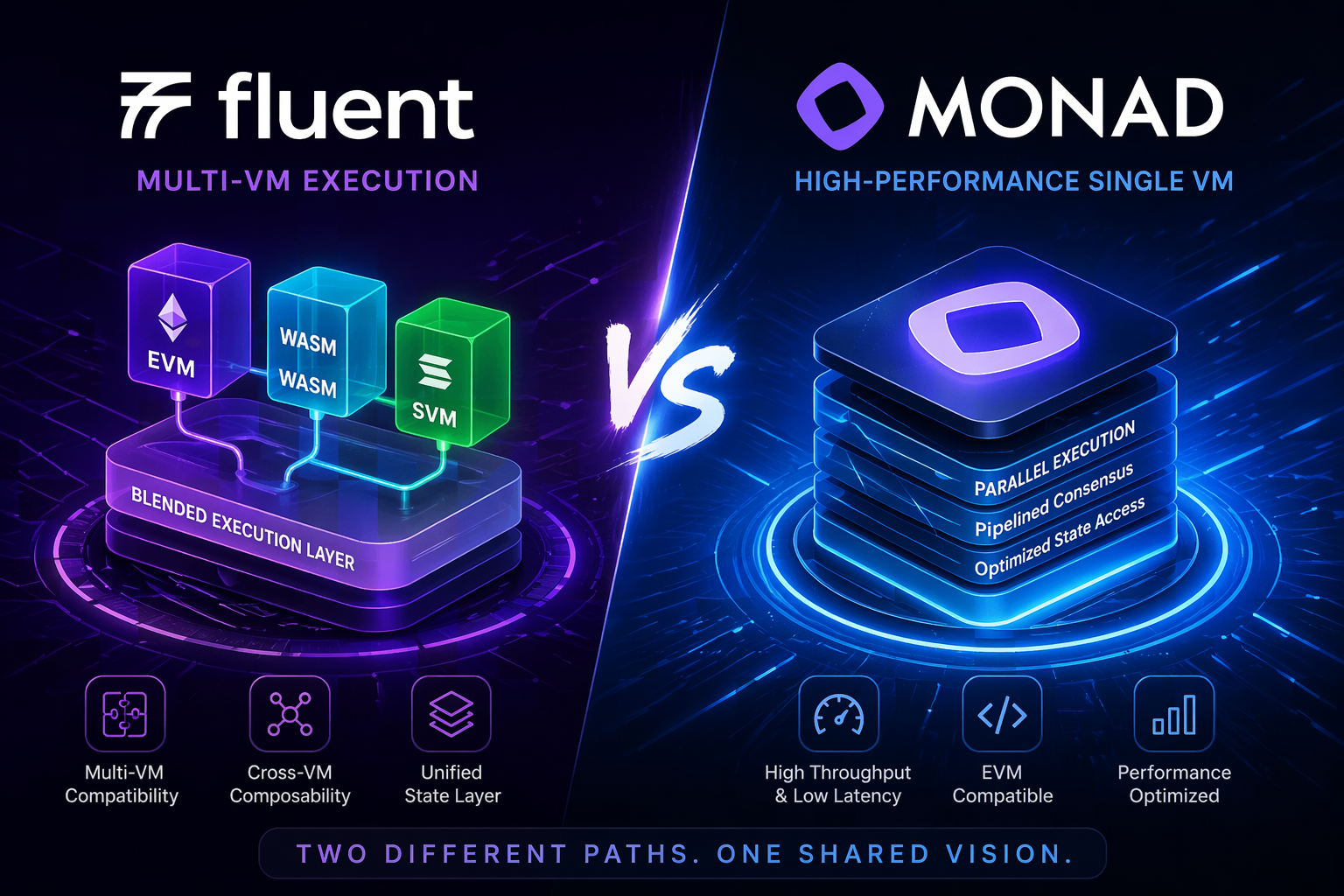
The core difference between Fluent and Monad is that Fluent enables cross-environment execution through multi-virtual-machine fusion, while Monad pursues maximum performance by optimizing a single virtual machine.

As blockchain scaling paths continue to evolve, different projects have adopted different execution-layer strategies. Some improve composability by integrating multiple execution environments, while others improve performance by optimizing a single execution path. When developers choose infrastructure, they often need to weigh flexibility against performance.

This issue usually involves three layers: architectural design, execution mechanisms, and resource allocation. Together, these dimensions determine the technical path and ecosystem direction of different networks.

Fluent vs Monad: Analyzing the Differences Between Multi-VM Execution and High-Performance Single VM Architectures

What Is Fluent?

Fluent can be understood as a network that supports coordinated execution across multiple virtual machines. Its core purpose is to integrate different computing environments through a unified execution layer.

At the mechanism level, Fluent allows different virtual machines, such as EVM and Wasm, to run within the same system and supports cross-virtual-machine calls. This enables applications to share state and logic across multiple execution environments.

Structurally, this design depends on an abstract execution layer that wraps different virtual machines into a unified interface, making cross-environment interaction possible. As a result, developers can build complex applications with multiple execution paths within a single system.

The significance of this model is that it improves system composability, allowing tools and logic from different ecosystems to be integrated into one execution framework.

What Is Monad?

Monad can be understood as a single-virtual-machine blockchain focused on high-performance execution. Its core purpose is to achieve high throughput and low latency by optimizing the execution path.

At the mechanism level, Monad is based on the EVM and improves execution efficiency through parallel execution, pipelined processing, and state optimization, allowing a single virtual machine to handle more transactions.

Structurally, this design is built around a single-VM system. It improves performance through deep optimization of the execution process rather than introducing multiple execution environments. This makes the system structure more concentrated.

The significance of this model is that it substantially improves execution efficiency while preserving an environment familiar to developers.

Differences Between Fluent and Monad in Architectural Design

The architectural divergence between the two lies in how execution environments are organized.

At the mechanism level, Fluent enables cross-environment execution through multi-virtual-machine fusion, while Monad improves execution efficiency through single-virtual-machine optimization. These represent two entirely different scaling paths.

Structurally, Fluent requires an additional abstraction layer to coordinate calls and state sharing between different virtual machines. Monad, by contrast, keeps a single execution environment and improves performance by optimizing the execution engine.

Dimension Fluent Monad
Execution model Multi-VM fusion Single VM
Architectural path Abstract integration Deep optimization
System complexity Relatively high Relatively low
Composability High Medium
Performance improvement method Architectural-layer fusion Execution-layer optimization

This difference means the two have fundamentally different system design goals: one emphasizes extensibility, while the other emphasizes execution efficiency.

How Execution Mechanisms Differ Between Fluent and Monad

Execution mechanisms determine how transactions are processed.

At the mechanism level, Fluent supports cross-virtual-machine execution, so a transaction may be completed in stages across several execution environments. Monad, on the other hand, completes all execution within a single virtual machine and increases throughput through parallel processing.

Structurally, Fluent’s execution flow is more complex because it must coordinate call relationships between different virtual machines. Monad’s execution flow is more centralized, improving efficiency through optimized scheduling.

The significance of this difference is that Fluent is better suited to applications with complex logic, while Monad is better suited to high-frequency trading and performance-sensitive scenarios.

How Incentive Mechanisms Are Designed in Fluent and Monad

Incentive mechanisms reflect how resources are allocated.

At the mechanism level, Fluent’s incentives need to cover multiple types of participants, including execution nodes and validation nodes, in order to support multi-virtual-machine coordination. Monad’s incentives, by contrast, mainly revolve around nodes within a single execution system.

Structurally, Fluent’s incentive structure is more complex and needs to allocate rewards to different execution roles, while Monad’s incentive structure is relatively concentrated.

The significance of this design is that Fluent uses multi-layer incentives to support complex system operation, while Monad uses more concentrated incentives to improve efficiency.

How State Management and Control Are Distributed

State management determines system consistency.

At the mechanism level, Fluent manages multi-virtual-machine execution results through a unified state layer, allowing different execution environments to share state. Monad, by contrast, maintains state within a single virtual machine, avoiding the synchronization issues that arise across environments.

Structurally, Fluent’s state management must handle cross-VM consistency, while Monad’s state management is more direct.

This difference means Fluent offers greater flexibility, but also requires a more complex coordination mechanism. Monad has an advantage in structural simplicity.

Differences in Use Cases and Ecosystem Paths

Use cases show how each technical path is applied in practice.

At the mechanism level, Fluent is better suited to applications that need cross-execution environments, such as multi-language smart contracts and complex composable logic. Monad is better suited to high-throughput scenarios, such as high-frequency trading and large-scale applications.

Structurally, Fluent’s ecosystem leans more toward diversity and cross-system integration, while Monad’s ecosystem is more focused on performance-driven applications.

This difference gives the two distinct ecosystem development paths: one emphasizes diversity, while the other emphasizes efficiency.

Summary

Fluent and Monad represent two different scaling paths: multi-virtual-machine fusion and single-virtual-machine optimization. Their differences appear across architectural design, execution mechanisms, ecosystem direction, and more.

FAQ

What Is the Core Difference Between Fluent and Monad?

Fluent emphasizes coordinated execution across multiple virtual machines, while Monad focuses on optimizing single-virtual-machine performance.

Is Fluent More Flexible Than Monad?

In terms of execution environments and composability, Fluent is generally more flexible.

Where Are Monad’s Main Advantages?

They mainly appear in high-throughput and low-latency execution performance.

Do Their Use Cases Overlap?

Some scenarios do overlap, but complex applications are better suited to Fluent, while high-performance scenarios are better suited to Monad.

Which Architecture Is More Scalable?

It depends on the need. A multi-virtual-machine architecture has more advantages for functional expansion, while a single-virtual-machine architecture offers a more direct path for performance scaling.

Author: Carlton
Translator: Jared
Disclaimer
* The information is not intended to be and does not constitute financial advice or any other recommendation of any sort offered or endorsed by Gate.
* This article may not be reproduced, transmitted or copied without referencing Gate. Contravention is an infringement of Copyright Act and may be subject to legal action.

Related Articles

The Future of Cross-Chain Bridges: Full-Chain Interoperability Becomes Inevitable, Liquidity Bridges Will Decline
Beginner

The Future of Cross-Chain Bridges: Full-Chain Interoperability Becomes Inevitable, Liquidity Bridges Will Decline

This article explores the development trends, applications, and prospects of cross-chain bridges.
2026-04-08 17:11:27
Solana Need L2s And Appchains?
Advanced

Solana Need L2s And Appchains?

Solana faces both opportunities and challenges in its development. Recently, severe network congestion has led to a high transaction failure rate and increased fees. Consequently, some have suggested using Layer 2 and appchain technologies to address this issue. This article explores the feasibility of this strategy.
2026-04-06 23:31:03
Sui: How are users leveraging its speed, security, & scalability?
Intermediate

Sui: How are users leveraging its speed, security, & scalability?

Sui is a PoS L1 blockchain with a novel architecture whose object-centric model enables parallelization of transactions through verifier level scaling. In this research paper the unique features of the Sui blockchain will be introduced, the economic prospects of SUI tokens will be presented, and it will be explained how investors can learn about which dApps are driving the use of the chain through the Sui application campaign.
2026-04-07 01:11:45
Navigating the Zero Knowledge Landscape
Advanced

Navigating the Zero Knowledge Landscape

This article introduces the technical principles, framework, and applications of Zero-Knowledge (ZK) technology, covering aspects from privacy, identity (ID), decentralized exchanges (DEX), to oracles.
2026-04-08 15:08:18
What is Tronscan and How Can You Use it in 2025?
Beginner

What is Tronscan and How Can You Use it in 2025?

Tronscan is a blockchain explorer that goes beyond the basics, offering wallet management, token tracking, smart contract insights, and governance participation. By 2025, it has evolved with enhanced security features, expanded analytics, cross-chain integration, and improved mobile experience. The platform now includes advanced biometric authentication, real-time transaction monitoring, and a comprehensive DeFi dashboard. Developers benefit from AI-powered smart contract analysis and improved testing environments, while users enjoy a unified multi-chain portfolio view and gesture-based navigation on mobile devices.
2026-03-24 11:52:42
What Is Ethereum 2.0? Understanding The Merge
Intermediate

What Is Ethereum 2.0? Understanding The Merge

A change in one of the top cryptocurrencies that might impact the whole ecosystem
2026-04-09 09:17:06