Bitcoin Price Prediction: Will It Plunge 50%? In-Depth Analysis of Technical Indicators and Bottom Targets

Last Updated 2026-03-30 04:12:53
Reading Time: 1m
Crypto analyst FriendlyRox warns that as both trading volume and momentum weaken, Bitcoin could potentially fall back to around $60,000, discussing key technical indicators and market risks.

Current Bitcoin market overview


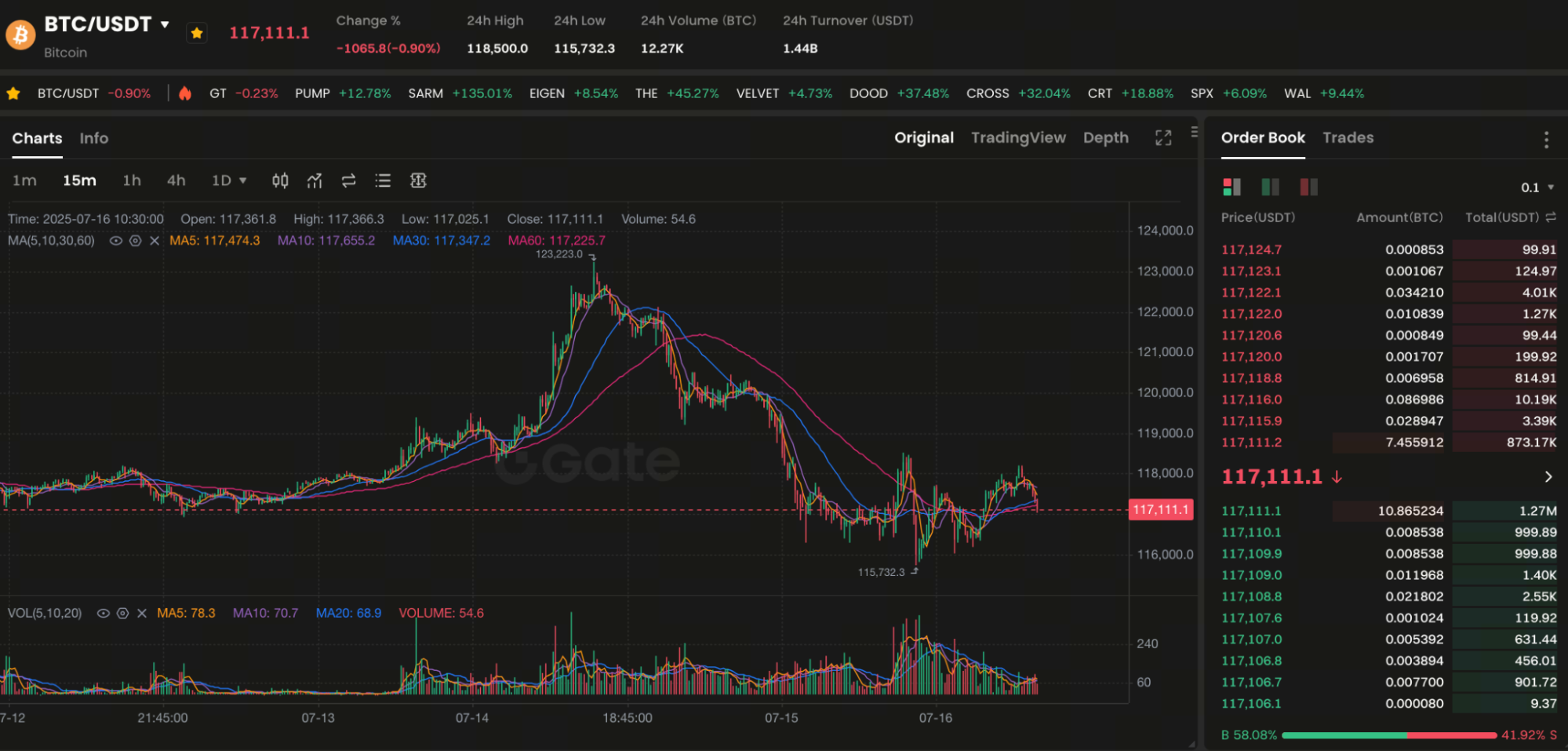
Figure:https://www.gate.com/trade/BTC_USDT

As of July 16, the price of Bitcoin has remained in the range of $117,000-$119,000, down more than 5% from the previous historical high of $123,091. Although the long-term bullish sentiment remains, recent data shows that market momentum is weak, with trading volume continuing to decline, reflecting a lack of buying power in the short term.

Analysis of Trading Volume and Momentum Indicators

FriendlyRox pointed out that the last three big dumps of Bitcoin were accompanied by a decline in trading volume and RSI divergence. This round of market is similar:

  • The daily trading volume has dropped from an average of $125 billion in June to around $96 billion;
  • The RSI (Relative Strength Index) quickly fell after reaching 74 on July 10;
  • MACD signal bars weaken, indicating a lack of strength in price increase.

These technical indicator changes indicate that the “50% Bitcoin Price Crash” is not without basis.

50 EMA and Key Support Level Analysis

The technical chart shows that Bitcoin is currently above the uptrend line since the end of 2024, but if it falls further below $110,000, the next support will be at the intersection of $90,000 and the 50-day Exponential Moving Average (EMA). The bottom area that FriendlyRox believes—$60,000—is just below the historical support level of that moving average, which is also the previous bull market high.

Analyst Prediction Logic Interpretation

FriendlyRox’s predictions are mainly based on the following three points:

  1. The market is thinly traded at high levels, making it susceptible to bearish pressure.
  2. The growth of ETF holdings is slowing down, and institutional fund attitudes are conservative;
  3. Bitcoin price has strayed too far from the 50 EMA, which may lead to a technical mean reversion.

History also shows that the two rounds of big dumps in 2021 and 2022 occurred after BTC increased by more than 3 times, and the current stage is highly similar.

How should investors respond?

In the face of a potential 50% pullback, novice investors can refer to the following strategies:

  • Gradual position building/profit-taking and stop-loss mechanism improvement: Set trading plans with support at $105,000, $90,000, $75,000;
  • Hedge risks with options tools: use put options to protect long positions;
  • Reduce leverage, retain cash flow: control risk exposure and enhance the safety of funds.
  • Extend the investment period and reduce the impact of fluctuations: long-term regular investment can smooth out the risks brought by price fluctuations.

Conclusion

The “50% Bitcoin Price Crash” is not an exaggeration, but a possible market correction path. As a novice investor, it is important to understand the technical indicators and market mechanisms, carefully formulate investment strategies, and reasonably allocate positions to cope with potential price fluctuations in the future.

Author: Max
Disclaimer
* The information is not intended to be and does not constitute financial advice or any other recommendation of any sort offered or endorsed by Gate.
* This article may not be reproduced, transmitted or copied without referencing Gate. Contravention is an infringement of Copyright Act and may be subject to legal action.

Related Articles

AI-Native Settlement Layers: How United Stables Is Building the Next Financial Rail
Beginner

AI-Native Settlement Layers: How United Stables Is Building the Next Financial Rail

Stablecoins were originally designed as dollar substitutes within exchanges, primarily used for asset pricing and trade settlement. As on-chain financial ecosystems have matured, their role has expanded beyond simple payments to include collateral assets, cross-chain liquidity mediums, and unified settlement units. In particular, as AI systems and automated agents begin to participate directly in economic activity, demand has risen sharply for programmable value units capable of instant settlement. This shift is pushing stablecoins toward the role of foundational financial infrastructure.
2026-03-25 03:16:17
The ve(3,3) Flywheel Explained: How AERO Tokenomics Powers Aerodrome’s DeFi Economy
Beginner

The ve(3,3) Flywheel Explained: How AERO Tokenomics Powers Aerodrome’s DeFi Economy

In the competition for DeFi liquidity, high-inflation mining alone is no longer enough to build lasting advantages. Aerodrome applies the ve(3,3) economic model to redesign token emissions, voting mechanisms, and revenue distribution, creating a liquidity flywheel centered on governance and cash flow. This article examines AERO tokenomics, the veAERO locking mechanism, and protocol revenue models to explain how Aerodrome builds a sustainable DeFi economic system.
2026-03-25 06:41:58
DePIN Identity Network and Real World Applications: How Humanity Protocol Brings on-chain Identity Into the Physical World
Beginner

DePIN Identity Network and Real World Applications: How Humanity Protocol Brings on-chain Identity Into the Physical World

Most Web3 identity systems remain confined to on-chain environments and struggle to achieve meaningful adoption in real world settings. Through a DePIN architecture and physical verification hardware, Humanity Protocol aims to bring decentralized identity into access control systems, hospitality, public services, and offline events, allowing on-chain identity to function not just as a digital credential, but as foundational infrastructure for real world access.
2026-03-25 07:40:53
Aerodrome Tokenomics: How ve(3,3) Powers Base's Most Profitable DEX
Beginner

Aerodrome Tokenomics: How ve(3,3) Powers Base's Most Profitable DEX

AERO is the native token of Aerodrome Finance, a core decentralized exchange and liquidity protocol in the Base ecosystem. It is primarily used for liquidity incentives and ecosystem operations. veAERO is a governance NFT that users receive by locking AERO, representing both voting power and the right to share protocol revenue. Through a dual track structure of AERO as a utility token and veAERO as a governance credential, Aerodrome separates liquidity usage value from long term governance power, allowing participants to act as liquidity providers, governance decision makers, and revenue sharers within the same system.
2026-03-25 06:40:31
Aster vs Hyperliquid: Which Perp DEX Will Prevail?
Beginner

Aster vs Hyperliquid: Which Perp DEX Will Prevail?

Aster and Hyperliquid are the two representative protocols of the "purpose-built L1 path" within the current decentralized perpetual exchange (Perp DEX) sector. As a pioneer in the field, Hyperliquid has built a deep liquidity moat through its highly mature order book architecture and strong community consensus. Conversely, Aster, as a rising challenger, seeks to leapfrog the competition in high-performance trading through more aggressive multi-chain aggregation logic, private transaction modules, and an underlying execution environment optimized for 2026 market demands.
2026-03-24 11:58:33
Gold Price Forecast for the Next Five Years: 2026–2030 Trend Outlook and Investment Implications, Could It Reach $6,000?
Beginner

Gold Price Forecast for the Next Five Years: 2026–2030 Trend Outlook and Investment Implications, Could It Reach $6,000?

Analyze current gold price trends alongside authoritative five-year forecasts, integrating an evaluation of market risks and opportunities. This gives investors insight into the potential trajectory of gold prices and the main drivers expected to shape the market over the next five years.
2026-03-25 18:13:30