Bitcoin Crashes to $86,000 as Owen Gunden Whales Dump $1.3B BTC, Triggering Market Panic

Beginner
Quick Reads
Last Updated 2026-03-27 15:06:56
Reading Time: 1m
Bitcoin abruptly dropped to about $86,000. Owen Gunden—a major whale who joined the market in 2011—sold roughly $1.3 billion in Bitcoin, sparking a ripple effect throughout the market. This article examines the causes of the plunge, whale movements, market sentiment, and possible future directions to help investors identify opportunities and risks during this period of heightened volatility.


Image: https://x.com/lookonchain/status/1991322573112766740

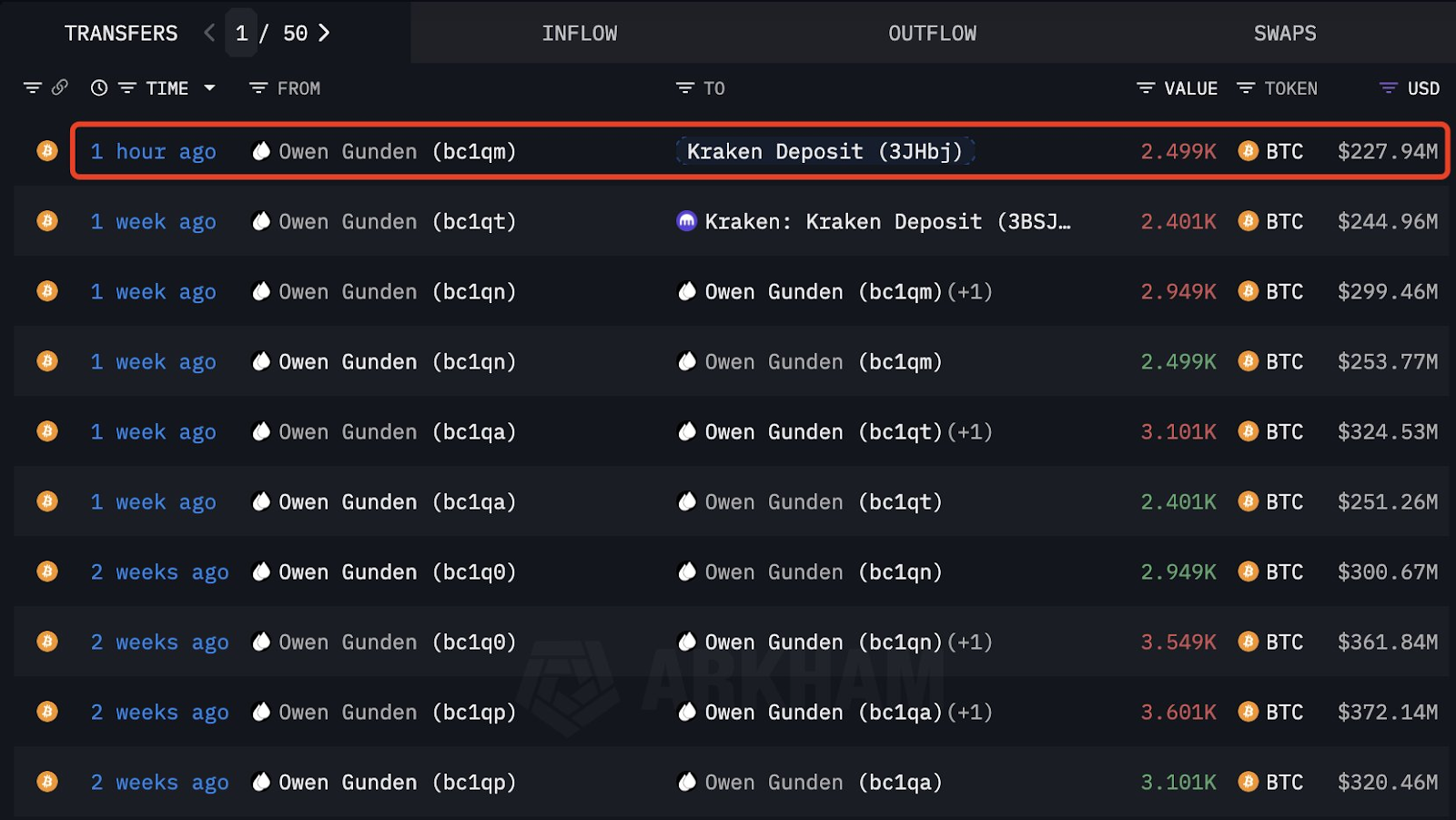
In November 2025, the Bitcoin market saw a rare and rapid correction. The price held near record highs but then suddenly reversed and plunged to about $86,000 in a short span, sparking widespread debate across the crypto community. This decline resulted from a combination of factors rather than a single cause. The most significant was the decision by whale Owen Gunden—an investor with over a decade in the market—to liquidate his entire position, selling off roughly $1.3 billion in Bitcoin at once.

Why Did Bitcoin Suddenly Crash?

Bitcoin’s price is naturally sensitive to both sentiment and major events. Several critical factors combined to drive this downturn.

Technical Support Breakdown

Over recent weeks, the $90,000 level was tested multiple times without meaningful rebound. When this crucial support finally gave way, a cascade of stop-loss orders triggered, accelerating the price drop.

Macroeconomic Pressure

Global monetary policy remains tight, with increased sensitivity to interest rate shifts. Overall risk appetite has fallen, prompting broad sell-offs in risk assets like Bitcoin.

Cascading Derivatives Liquidations

The sharp price decline triggered mass liquidations of leveraged long positions, further amplifying short-term losses.

$1.3 Billion Whale Sell-Off: The Amount Isn’t Massive, but the Signal Is Critical

The most disruptive event was an early investor, holding since 2011, suddenly selling everything. Roughly 11,000 BTC were moved on-chain and ultimately liquidated, totaling over $1.3 billion.

Why did this trigger panic?

  • Long-term holders rarely exit entirely during a bull market: This suggests to many market participants that upside potential may be limited.
  • Massive sell orders can impact short-term liquidity: Large dumps tend to spark additional selling pressure.
  • On-chain transparency amplifies whale moves: Every whale action is quickly broadcast and magnified, fueling volatility.

As a result, once the whale began to sell, market optimism quickly gave way to caution—and even panic—pushing Bitcoin lower.

Panic Spreads: Capital Shifts to Safe Havens

As the price plunged, market panic increased. Trading volume increased, but buying demand lagged, and the market entered a short period of risk aversion.

Key themes surfaced in the community:

  • Growing debate over whether the top is in
  • Bullish confidence dropping, with more investors waiting on the sidelines
  • Some investors are opting to proactively reduce their exposure
  • Altcoins slumping in tandem, widening overall losses

As a result, sentiment is rapidly shifting from euphoria to caution.

Three Potential Paths for Bitcoin

Looking ahead, Bitcoin could follow one of three main trajectories:

Scenario 1: Consolidation Between $80,000 and $90,000

If the market digests the whale’s sell-off quickly and liquidity stabilizes, Bitcoin may trade sideways at elevated levels.

Scenario 2: Correction Toward $70,000

If macro headwinds persist and leverage continues to unwind, there’s room for further downside.

Scenario 3: Swift Rebound, Challenging $95,000+

If institutions step in to accumulate at lower levels, Bitcoin could regain bullish momentum.

At present, further consolidation or even another dip seems more likely. However, monitoring capital inflows remains essential.

What Should Retail Investors Do Now?

During heightened volatility, new and everyday investors should stay calm and disciplined:

  • Avoid buying during rapid price increases or selling in panic to limit emotional trading
  • Reduce leverage and keep positions flexible
  • Use a staggered buying strategy—avoid going all-in at once
  • Set reasonable stop-loss levels
  • Monitor on-chain data and whale activity closely

For long-term investors, strategically accumulating during price dips remains a viable approach; however, timing is crucial.

Disclaimer
* The information is not intended to be and does not constitute financial advice or any other recommendation of any sort offered or endorsed by Gate.
* This article may not be reproduced, transmitted or copied without referencing Gate. Contravention is an infringement of Copyright Act and may be subject to legal action.

Related Articles

AI-Native Settlement Layers: How United Stables Is Building the Next Financial Rail
Beginner

AI-Native Settlement Layers: How United Stables Is Building the Next Financial Rail

Stablecoins were originally designed as dollar substitutes within exchanges, primarily used for asset pricing and trade settlement. As on-chain financial ecosystems have matured, their role has expanded beyond simple payments to include collateral assets, cross-chain liquidity mediums, and unified settlement units. In particular, as AI systems and automated agents begin to participate directly in economic activity, demand has risen sharply for programmable value units capable of instant settlement. This shift is pushing stablecoins toward the role of foundational financial infrastructure.
2026-03-25 03:16:17
The ve(3,3) Flywheel Explained: How AERO Tokenomics Powers Aerodrome’s DeFi Economy
Beginner

The ve(3,3) Flywheel Explained: How AERO Tokenomics Powers Aerodrome’s DeFi Economy

In the competition for DeFi liquidity, high-inflation mining alone is no longer enough to build lasting advantages. Aerodrome applies the ve(3,3) economic model to redesign token emissions, voting mechanisms, and revenue distribution, creating a liquidity flywheel centered on governance and cash flow. This article examines AERO tokenomics, the veAERO locking mechanism, and protocol revenue models to explain how Aerodrome builds a sustainable DeFi economic system.
2026-03-25 06:41:58
Aerodrome Tokenomics: How ve(3,3) Powers Base's Most Profitable DEX
Beginner

Aerodrome Tokenomics: How ve(3,3) Powers Base's Most Profitable DEX

AERO is the native token of Aerodrome Finance, a core decentralized exchange and liquidity protocol in the Base ecosystem. It is primarily used for liquidity incentives and ecosystem operations. veAERO is a governance NFT that users receive by locking AERO, representing both voting power and the right to share protocol revenue. Through a dual track structure of AERO as a utility token and veAERO as a governance credential, Aerodrome separates liquidity usage value from long term governance power, allowing participants to act as liquidity providers, governance decision makers, and revenue sharers within the same system.
2026-03-25 06:40:31
How Does PAXG Work? In-Depth Overview of the Physical Gold Tokenization Mechanism
Beginner

How Does PAXG Work? In-Depth Overview of the Physical Gold Tokenization Mechanism

PAXG (Pax Gold) is a tokenized asset backed by physical gold, issued by the fintech company Paxos and traded on the Ethereum blockchain as an ERC-20 token. The core concept is to tokenize physical gold on-chain, with each PAXG token representing ownership of a certain amount of gold. This structure enables investors to hold and trade gold in the form of a digital asset.
2026-03-24 19:12:51
How is the price of PAXG determined? Pegging mechanism, trading depth, and influencing factors
Beginner

How is the price of PAXG determined? Pegging mechanism, trading depth, and influencing factors

PAXG (Pax Gold) is a tokenized asset backed by physical gold reserves, launched by fintech firm Paxos and issued as an ERC-20 token on the Ethereum blockchain. The core concept is to digitally represent real-world gold assets, allowing investors to hold and trade gold via the blockchain network. Because each PAXG token corresponds to a specific quantity of physical gold, its price is theoretically expected to closely track the global gold market.
2026-03-24 19:11:40
DePIN Identity Network and Real World Applications: How Humanity Protocol Brings on-chain Identity Into the Physical World
Beginner

DePIN Identity Network and Real World Applications: How Humanity Protocol Brings on-chain Identity Into the Physical World

Most Web3 identity systems remain confined to on-chain environments and struggle to achieve meaningful adoption in real world settings. Through a DePIN architecture and physical verification hardware, Humanity Protocol aims to bring decentralized identity into access control systems, hospitality, public services, and offline events, allowing on-chain identity to function not just as a digital credential, but as foundational infrastructure for real world access.
2026-03-25 07:40:53





