As Safe-Haven Demand and Inflation Expectations Intertwine, Metal Trading Heats Up — Gate Metals Zone Opens New Access Paths

Beginner
Quick Reads
Last Updated 2026-03-24 23:54:38
Reading Time: 1m
Amid ongoing shifts in risk sentiment and inflation expectations, trading activity in the metals market has remained robust. This article examines market characteristics through the lens of capital dynamics and market structure, and explains how the Gate Metals section provides investors with a more efficient approach to trading participation.

Risk Aversion and Inflation Expectations Boost Metals Market Attention

Global market sentiment has recently been oscillating between risk appetite and safe-haven demand. While some economic data remains strong, growth in certain regions is slowing, prompting cautious outlooks for the economy’s future. At the same time, shifting inflation expectations and evolving policy paths continue to reshape asset price structures.

In this environment, metals have returned to the spotlight among investors. Gold and silver are in focus due to their historic safe-haven roles, while industrial metals are gaining new trading momentum driven by expectations for industrial upgrades and rising demand from the new energy sector.

This combined dynamic is significantly increasing overall activity in the metals market.

Metals Market Structure Is Undergoing Transformation

Unlike previous periods dominated by single trends, the current metals market is displaying more complex structural features. Prices often surge rapidly in the short term, then consolidate, and subsequently shift direction based on new data or changing expectations.

This “event-driven plus expectation trading” structure makes the market more dependent on information flow and timing. Price responses to macroeconomic data, policy signals, and industry news have become noticeably faster.

At the same time, increasing participation from institutions and quantitative strategies is making price swings more frequent and accelerating trading pace.

New Patterns in Capital Behavior Amid Volatility

During heightened volatility, capital behavior typically shows three distinct traits:

  • First, holding periods are shorter. Many traders prefer phased participation over long-term holding.
  • Second, asset rotation speeds up. Funds move frequently among metals, stocks, and digital assets.
  • Third, risk management becomes a priority. Investors focus more on position sizing and managing drawdowns.

In this environment, platform flexibility and execution efficiency are crucial. Platforms that offer convenient operations and a stable trading experience are more likely to attract users.

How Gate’s Metals Section Addresses Diverse Needs
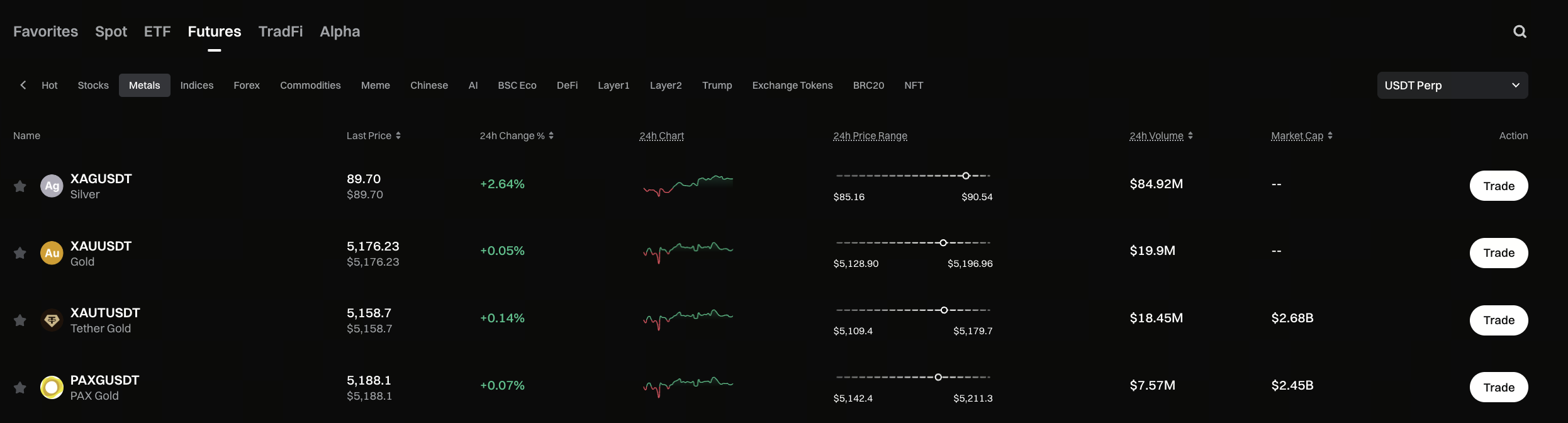

Figure: https://www.gate.com/price/futures/category-metals/usdt

Gate’s dedicated metals section gives users a centralized gateway for metals trading, allowing investors to monitor multiple metal assets within a unified trading environment. By integrating the trading interface and account system, users can execute strategies more efficiently and streamline their operations. In fast-moving markets, this centralized approach reduces operational steps and speeds up decision-making.

Additionally, the digital trading environment removes traditional time restrictions, so investors can participate flexibly in response to global market dynamics. For users already accustomed to digital asset trading, the metals section is an important addition for broadening asset classes.

Integration of Metals Trading and Multi-Asset Strategies

As traditional and digital assets increasingly merge, investors are no longer confined to a single market when building portfolios. Metals and other asset classes perform differently across economic cycles, creating more opportunities for portfolio diversification.

Multi-asset trading on a single platform enhances capital allocation efficiency and smooths strategy execution. For users aiming to build diversified investment structures, this integrated environment offers clear advantages.

Rational Participation in Complex Market Conditions

While metals market trading activity is rising, high volatility also brings higher risk. Rationally assessing market structure, allocating positions wisely, and avoiding emotional trading are essential for successful participation.

With risk aversion and inflation expectations shifting, metals are likely to remain highly active. Choosing a stable and convenient trading environment helps maintain pace and efficiency in uncertain markets.

Gate’s metals section gives investors greater flexibility and opens new possibilities for multi-asset trading trends.

Author: Max
Disclaimer
* The information is not intended to be and does not constitute financial advice or any other recommendation of any sort offered or endorsed by Gate.
* This article may not be reproduced, transmitted or copied without referencing Gate. Contravention is an infringement of Copyright Act and may be subject to legal action.

Related Articles

AI-Native Settlement Layers: How United Stables Is Building the Next Financial Rail
Beginner

AI-Native Settlement Layers: How United Stables Is Building the Next Financial Rail

Stablecoins were originally designed as dollar substitutes within exchanges, primarily used for asset pricing and trade settlement. As on-chain financial ecosystems have matured, their role has expanded beyond simple payments to include collateral assets, cross-chain liquidity mediums, and unified settlement units. In particular, as AI systems and automated agents begin to participate directly in economic activity, demand has risen sharply for programmable value units capable of instant settlement. This shift is pushing stablecoins toward the role of foundational financial infrastructure.
2026-03-25 03:16:17
The ve(3,3) Flywheel Explained: How AERO Tokenomics Powers Aerodrome’s DeFi Economy
Beginner

The ve(3,3) Flywheel Explained: How AERO Tokenomics Powers Aerodrome’s DeFi Economy

In the competition for DeFi liquidity, high-inflation mining alone is no longer enough to build lasting advantages. Aerodrome applies the ve(3,3) economic model to redesign token emissions, voting mechanisms, and revenue distribution, creating a liquidity flywheel centered on governance and cash flow. This article examines AERO tokenomics, the veAERO locking mechanism, and protocol revenue models to explain how Aerodrome builds a sustainable DeFi economic system.
2026-03-25 06:41:58
Aerodrome Tokenomics: How ve(3,3) Powers Base's Most Profitable DEX
Beginner

Aerodrome Tokenomics: How ve(3,3) Powers Base's Most Profitable DEX

AERO is the native token of Aerodrome Finance, a core decentralized exchange and liquidity protocol in the Base ecosystem. It is primarily used for liquidity incentives and ecosystem operations. veAERO is a governance NFT that users receive by locking AERO, representing both voting power and the right to share protocol revenue. Through a dual track structure of AERO as a utility token and veAERO as a governance credential, Aerodrome separates liquidity usage value from long term governance power, allowing participants to act as liquidity providers, governance decision makers, and revenue sharers within the same system.
2026-03-25 06:40:31
How Does PAXG Work? In-Depth Overview of the Physical Gold Tokenization Mechanism
Beginner

How Does PAXG Work? In-Depth Overview of the Physical Gold Tokenization Mechanism

PAXG (Pax Gold) is a tokenized asset backed by physical gold, issued by the fintech company Paxos and traded on the Ethereum blockchain as an ERC-20 token. The core concept is to tokenize physical gold on-chain, with each PAXG token representing ownership of a certain amount of gold. This structure enables investors to hold and trade gold in the form of a digital asset.
2026-03-24 19:12:51
How is the price of PAXG determined? Pegging mechanism, trading depth, and influencing factors
Beginner

How is the price of PAXG determined? Pegging mechanism, trading depth, and influencing factors

PAXG (Pax Gold) is a tokenized asset backed by physical gold reserves, launched by fintech firm Paxos and issued as an ERC-20 token on the Ethereum blockchain. The core concept is to digitally represent real-world gold assets, allowing investors to hold and trade gold via the blockchain network. Because each PAXG token corresponds to a specific quantity of physical gold, its price is theoretically expected to closely track the global gold market.
2026-03-24 19:11:40
DePIN Identity Network and Real World Applications: How Humanity Protocol Brings on-chain Identity Into the Physical World
Beginner

DePIN Identity Network and Real World Applications: How Humanity Protocol Brings on-chain Identity Into the Physical World

Most Web3 identity systems remain confined to on-chain environments and struggle to achieve meaningful adoption in real world settings. Through a DePIN architecture and physical verification hardware, Humanity Protocol aims to bring decentralized identity into access control systems, hospitality, public services, and offline events, allowing on-chain identity to function not just as a digital credential, but as foundational infrastructure for real world access.
2026-03-25 07:40:53





