ADA to PHP Latest Update: Why Cardano’s Price Surge Against the Philippine Peso Is Drawing Attention

Beginner
Quick Reads
Last Updated 2026-03-29 03:46:32
Reading Time: 1m
The current ADA to PHP exchange rate is roughly ₱50.60 per ADA. Over the past week, the rate has increased by nearly 8%. This article provides an analysis of the key drivers behind ADA's price movements. It also explores possible future trends. The content is relevant for those considering purchasing ADA with PHP and for existing holders assessing their investment decisions.


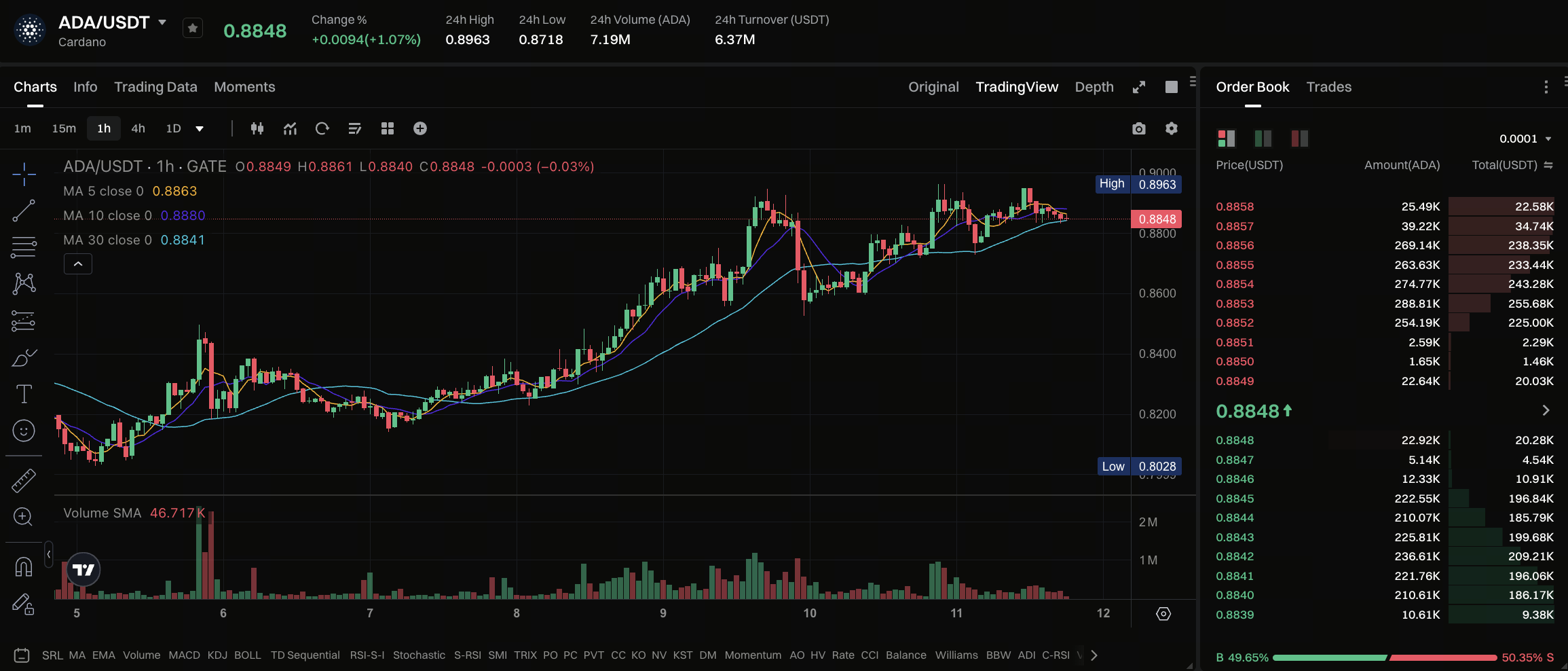
Chart: https://www.gate.com/trade/ADA_USDT
Over the past week, Cardano (ADA) has experienced an uptrend against the Philippine Peso (PHP). Currently, 1 ADA is valued at approximately ₱50.5. Compared to the lowest price in the previous seven days (roughly ₱46–₱47), this equates to a gain of about 7–8%.

Current ADA to PHP Price Overview

Presently, 1 ADA ≈ ₱50.5, which is a significant rise from last month’s ₱44–₱46 range. In other words, holders have seen an approximate 10% return over a short period.

Drivers Behind Recent Price Movements

Several factors have likely contributed to the ADA/PHP rally:

  • Improved market sentiment: The global crypto market has recently rebounded, attracting heightened investor interest.
  • Technical indicator support: ADA has persistently traded above multiple key moving averages, which bolsters investor confidence.
  • Enhanced liquidity: Price quotes across various exchanges have converged, resulting in a narrower bid-ask spread.
  • Regulatory clarity: Clearer guidance from the Philippine government regarding cryptocurrency regulation has allowed investors to more effectively assess potential risks.

The Impact of Bitcoin and Overall Market Sentiment on ADA

ADA operates within its own ecosystem and benefits from distinct technological advancements. However, Bitcoin’s price movements and global capital flows remain critical drivers. When Bitcoin climbs, capital often flows into the altcoin market, and ADA typically follows suit.

How Philippine Policy and Regulatory Environment Influence ADA Price

  • Regulatory clarity: Local regulators have implemented guidelines for crypto service providers, improving transparency.
  • Tax and legal risks: Policy shifts may reduce investor confidence.
  • Rising domestic demand: Increasing numbers of Filipino users are converting ADA to PHP, boosting overall market activity.

Guidance for Beginners: Safely Buying ADA and Exchanging ADA to PHP

  • Use reputable exchanges and avoid platforms that lack sufficient liquidity.
  • Be aware of transaction fees and slippage, especially during volatile periods.
  • Consider Dollar-Cost Averaging.
  • Set stop-loss orders to manage risk.
  • Stay informed about macroeconomic factors and Cardano’s technical updates.
  • For holding ADA long-term, consider storing it in a cold storage wallet for enhanced security.

Outlook and Risk Advisory

Outlook: If market optimism continues, ADA to PHP could surpass the ₱52–₱55 range in the near term.
Risks: Tightening regulatory conditions, broader macroeconomic headwinds, or stagnation in Cardano’s technological ecosystem could exert downward pressure on prices. Investors should remain cautious.

Author: Max
Disclaimer
* The information is not intended to be and does not constitute financial advice or any other recommendation of any sort offered or endorsed by Gate.
* This article may not be reproduced, transmitted or copied without referencing Gate. Contravention is an infringement of Copyright Act and may be subject to legal action.

Related Articles

The ve(3,3) Flywheel Explained: How AERO Tokenomics Powers Aerodrome’s DeFi Economy
Beginner

The ve(3,3) Flywheel Explained: How AERO Tokenomics Powers Aerodrome’s DeFi Economy

In the competition for DeFi liquidity, high-inflation mining alone is no longer enough to build lasting advantages. Aerodrome applies the ve(3,3) economic model to redesign token emissions, voting mechanisms, and revenue distribution, creating a liquidity flywheel centered on governance and cash flow. This article examines AERO tokenomics, the veAERO locking mechanism, and protocol revenue models to explain how Aerodrome builds a sustainable DeFi economic system.
2026-03-25 06:41:58
AI-Native Settlement Layers: How United Stables Is Building the Next Financial Rail
Beginner

AI-Native Settlement Layers: How United Stables Is Building the Next Financial Rail

Stablecoins were originally designed as dollar substitutes within exchanges, primarily used for asset pricing and trade settlement. As on-chain financial ecosystems have matured, their role has expanded beyond simple payments to include collateral assets, cross-chain liquidity mediums, and unified settlement units. In particular, as AI systems and automated agents begin to participate directly in economic activity, demand has risen sharply for programmable value units capable of instant settlement. This shift is pushing stablecoins toward the role of foundational financial infrastructure.
2026-03-25 03:16:17
Aerodrome Tokenomics: How ve(3,3) Powers Base's Most Profitable DEX
Beginner

Aerodrome Tokenomics: How ve(3,3) Powers Base's Most Profitable DEX

AERO is the native token of Aerodrome Finance, a core decentralized exchange and liquidity protocol in the Base ecosystem. It is primarily used for liquidity incentives and ecosystem operations. veAERO is a governance NFT that users receive by locking AERO, representing both voting power and the right to share protocol revenue. Through a dual track structure of AERO as a utility token and veAERO as a governance credential, Aerodrome separates liquidity usage value from long term governance power, allowing participants to act as liquidity providers, governance decision makers, and revenue sharers within the same system.
2026-03-25 06:40:31
How Does PAXG Work? In-Depth Overview of the Physical Gold Tokenization Mechanism
Beginner

How Does PAXG Work? In-Depth Overview of the Physical Gold Tokenization Mechanism

PAXG (Pax Gold) is a tokenized asset backed by physical gold, issued by the fintech company Paxos and traded on the Ethereum blockchain as an ERC-20 token. The core concept is to tokenize physical gold on-chain, with each PAXG token representing ownership of a certain amount of gold. This structure enables investors to hold and trade gold in the form of a digital asset.
2026-03-24 19:12:51
How is the price of PAXG determined? Pegging mechanism, trading depth, and influencing factors
Beginner

How is the price of PAXG determined? Pegging mechanism, trading depth, and influencing factors

PAXG (Pax Gold) is a tokenized asset backed by physical gold reserves, launched by fintech firm Paxos and issued as an ERC-20 token on the Ethereum blockchain. The core concept is to digitally represent real-world gold assets, allowing investors to hold and trade gold via the blockchain network. Because each PAXG token corresponds to a specific quantity of physical gold, its price is theoretically expected to closely track the global gold market.
2026-03-24 19:11:40
DePIN Identity Network and Real World Applications: How Humanity Protocol Brings on-chain Identity Into the Physical World
Beginner

DePIN Identity Network and Real World Applications: How Humanity Protocol Brings on-chain Identity Into the Physical World

Most Web3 identity systems remain confined to on-chain environments and struggle to achieve meaningful adoption in real world settings. Through a DePIN architecture and physical verification hardware, Humanity Protocol aims to bring decentralized identity into access control systems, hospitality, public services, and offline events, allowing on-chain identity to function not just as a digital credential, but as foundational infrastructure for real world access.
2026-03-25 07:40:53





