2026 Motley Fool 10 Best Stocks Investment Guide: Latest List and Stock Price Trend Analysis

Beginner
Quick Reads
Last Updated 2026-03-26 02:38:00
Reading Time: 1m
A complete breakdown of Motley Fool's 10 Best Stocks for 2026 features the latest recommendations and current price performance. This report highlights leading large-cap tech companies and long-term investment opportunities, offering valuable insights for investors.

What Is Motley Fool 10 Best Stocks?

The Motley Fool 10 Best Stocks is an annual selection published by the leading investment firm Motley Fool, designed for long-term growth investors. The list typically features 10 publicly traded companies identified as having strong long-term growth potential. Motley Fool’s recommendations are grounded in fundamental analysis, industry trends, and market outlook, providing investors with a foundation for building a buy-and-hold portfolio.

Keep in mind, these recommendations are not investment advice. Investors should evaluate their own risk tolerance and financial situation before participating.

2026 Latest Motley Fool Top 10 Stocks List

Based on the most recent market compilation and public reports as of early 2026, here are 10 top-performing stocks drawing significant market attention (referenced from Top 10 or popular picks):
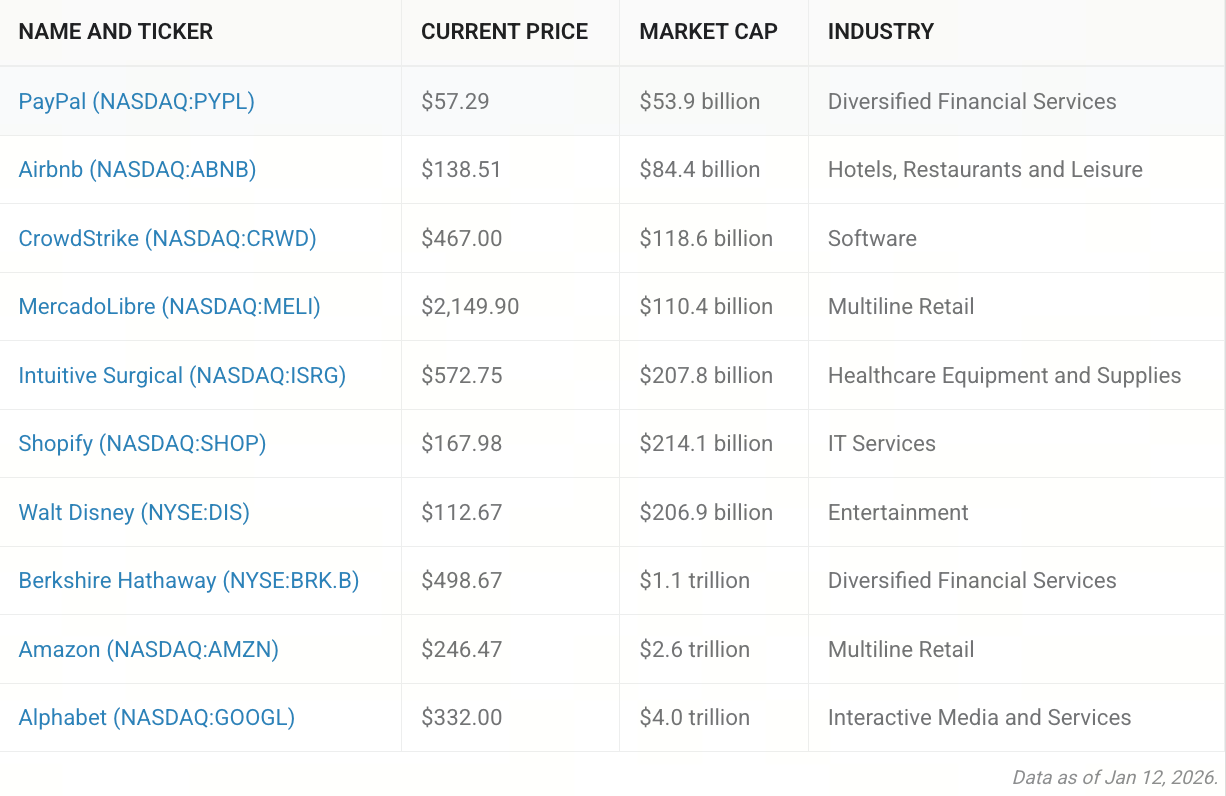
These stocks represent a range of industries, including technology, healthcare, consumer, and financial services, supporting the creation of a diversified investment portfolio.

Current Stock Performance and Market Trends

As 2026 begins, the market is experiencing structural divergence:

Technology Giants:

  • Alphabet (GOOGL) posted strong results in 2025, with stock prices rising on robust demand for AI and cloud services, at times leading gains among large-cap tech stocks.
  • Amazon (AMZN) saw modest gains in 2025, yet analysts remain focused on AWS cloud growth and improved operational efficiency.
  • Shopify (SHOP) and PayPal (PYPL), key players in e-commerce and payments, continue to offer long-term growth potential in the post-pandemic environment.

Healthcare and Consumer:

  • Intuitive Surgical (ISRG) benefits from steady demand for surgical robotics, maintaining solid fundamentals.
  • Airbnb (ABNB) continues to gain from the ongoing recovery in travel.

Blue-Chip and Diversified: Berkshire Hathaway (BRK.B) delivers consistent long-term results and exemplifies value and diversification.

Overall, the divide between technology and consumer sectors is becoming more pronounced. However, fundamentally strong companies remain the primary focus for long-term investors.

Investment Strategies: Long-Term vs. Short-Term Perspectives

Long-Term Investment Perspective

Motley Fool’s recommendations typically target compound growth over a five- to ten-year horizon. For growth-oriented tech companies such as Amazon, Alphabet, and Shopify, maintaining a long-term position can significantly increase overall returns.

Short-Term Strategy Considerations

Short-term price volatility is difficult to predict. Investors not committed to long-term holding should establish clear stop-loss and target profit levels, while closely monitoring macroeconomic conditions and industry trends. For example, cyclical shifts in AI and cloud computing can intensify short-term market swings.

Author: Max
Disclaimer
* The information is not intended to be and does not constitute financial advice or any other recommendation of any sort offered or endorsed by Gate.
* This article may not be reproduced, transmitted or copied without referencing Gate. Contravention is an infringement of Copyright Act and may be subject to legal action.

Related Articles

AI-Native Settlement Layers: How United Stables Is Building the Next Financial Rail
Beginner

AI-Native Settlement Layers: How United Stables Is Building the Next Financial Rail

Stablecoins were originally designed as dollar substitutes within exchanges, primarily used for asset pricing and trade settlement. As on-chain financial ecosystems have matured, their role has expanded beyond simple payments to include collateral assets, cross-chain liquidity mediums, and unified settlement units. In particular, as AI systems and automated agents begin to participate directly in economic activity, demand has risen sharply for programmable value units capable of instant settlement. This shift is pushing stablecoins toward the role of foundational financial infrastructure.
2026-03-25 03:16:17
The ve(3,3) Flywheel Explained: How AERO Tokenomics Powers Aerodrome’s DeFi Economy
Beginner

The ve(3,3) Flywheel Explained: How AERO Tokenomics Powers Aerodrome’s DeFi Economy

In the competition for DeFi liquidity, high-inflation mining alone is no longer enough to build lasting advantages. Aerodrome applies the ve(3,3) economic model to redesign token emissions, voting mechanisms, and revenue distribution, creating a liquidity flywheel centered on governance and cash flow. This article examines AERO tokenomics, the veAERO locking mechanism, and protocol revenue models to explain how Aerodrome builds a sustainable DeFi economic system.
2026-03-25 06:41:58
Aerodrome Tokenomics: How ve(3,3) Powers Base's Most Profitable DEX
Beginner

Aerodrome Tokenomics: How ve(3,3) Powers Base's Most Profitable DEX

AERO is the native token of Aerodrome Finance, a core decentralized exchange and liquidity protocol in the Base ecosystem. It is primarily used for liquidity incentives and ecosystem operations. veAERO is a governance NFT that users receive by locking AERO, representing both voting power and the right to share protocol revenue. Through a dual track structure of AERO as a utility token and veAERO as a governance credential, Aerodrome separates liquidity usage value from long term governance power, allowing participants to act as liquidity providers, governance decision makers, and revenue sharers within the same system.
2026-03-25 06:40:31
How Does PAXG Work? In-Depth Overview of the Physical Gold Tokenization Mechanism
Beginner

How Does PAXG Work? In-Depth Overview of the Physical Gold Tokenization Mechanism

PAXG (Pax Gold) is a tokenized asset backed by physical gold, issued by the fintech company Paxos and traded on the Ethereum blockchain as an ERC-20 token. The core concept is to tokenize physical gold on-chain, with each PAXG token representing ownership of a certain amount of gold. This structure enables investors to hold and trade gold in the form of a digital asset.
2026-03-24 19:12:51
How is the price of PAXG determined? Pegging mechanism, trading depth, and influencing factors
Beginner

How is the price of PAXG determined? Pegging mechanism, trading depth, and influencing factors

PAXG (Pax Gold) is a tokenized asset backed by physical gold reserves, launched by fintech firm Paxos and issued as an ERC-20 token on the Ethereum blockchain. The core concept is to digitally represent real-world gold assets, allowing investors to hold and trade gold via the blockchain network. Because each PAXG token corresponds to a specific quantity of physical gold, its price is theoretically expected to closely track the global gold market.
2026-03-24 19:11:40
Aster vs Hyperliquid: Which Perp DEX Will Prevail?
Beginner

Aster vs Hyperliquid: Which Perp DEX Will Prevail?

Aster and Hyperliquid are the two representative protocols of the "purpose-built L1 path" within the current decentralized perpetual exchange (Perp DEX) sector. As a pioneer in the field, Hyperliquid has built a deep liquidity moat through its highly mature order book architecture and strong community consensus. Conversely, Aster, as a rising challenger, seeks to leapfrog the competition in high-performance trading through more aggressive multi-chain aggregation logic, private transaction modules, and an underlying execution environment optimized for 2026 market demands.
2026-03-24 11:58:33





